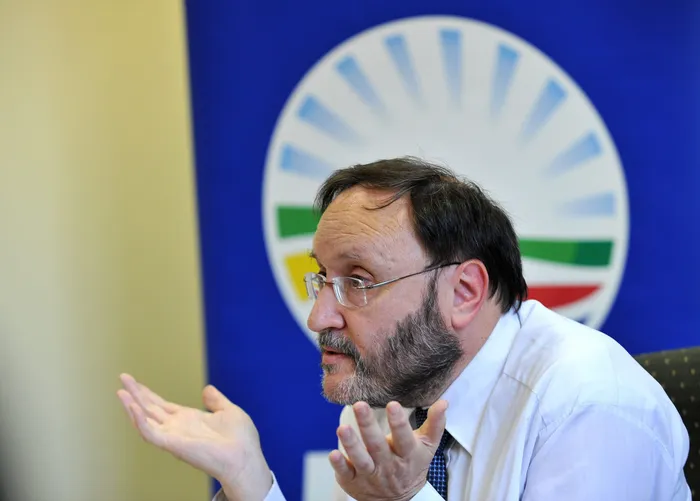
GQEBERHA, Monday 31 August 2026 — More than 60% of the water supplied through Nelson Mandela Bay is being lost or going unbilled, Deputy Water and Sanitation Minister Jack Bloom said on Monday, warning that the level of non-revenue water in one of South Africa’s most competitive metropolitan municipalities is unacceptable.
Bloom made the assessment after visiting the Nooitgedacht and Groendal water treatment works as part of an inspection of water and sanitation services in the metro.
His intervention puts renewed national attention on a long-running municipal infrastructure problem little more than two months before the 4 November local government elections.
Non-revenue water includes treated water physically lost through leaks and failing infrastructure, as well as water that is consumed but not billed because of illegal connections, theft or faulty meters.
South Africa’s national non-revenue water average is already high at 47.3%, according to the Department of Water and Sanitation’s No Drop assessment.
Nelson Mandela Bay’s rate exceeds 60%.
“We cannot do this as a water-scarce country, where we pump water from elsewhere, tap alternative water sources, then 40% of water is just lost in the network,” Bloom said.
He estimated that actual physical losses could account for between 30% and 40% of the metro’s water supply, although the precise proportion remains subject to measurement.
Bloom said the municipality currently had about 5,000 outstanding water-related complaints, many involving leaks.
He also identified theft and vandalism of municipal infrastructure as significant contributors to the problem.
The visit does not reveal the water-loss problem for the first time.
Nelson Mandela Bay’s own mid-year performance information showed that losses reached a record 60.39% during the first half of the 2025/26 financial year.
What Monday’s intervention adds is direct scrutiny from the newly appointed deputy minister and the possibility of stronger national oversight.
Bloom said the Department of Water and Sanitation would examine directives already issued to the municipality and said accountability and intervention remained options.
“It concerns me very deeply that our rivers get contaminated by sewage,” he said.
“There should be accountability, and there can be interventions.”
Nelson Mandela Bay infrastructure and engineering political head Buyelwa Mafaya said the municipality had approved a water conservation and demand-management strategy and appointed six teams to address leaks.
She said work was also under way on major pipelines, including infrastructure along the R75 between Gqeberha and Kariega and on Mission Road.
Mafaya acknowledged that ageing pipes, theft and vandalism were contributing to losses.
The scale of the infrastructure problem is substantial.
Municipal officials told councillors earlier this year that approximately 4,700 kilometres of ageing water pipelines required replacement, with some sections more than 40 years old.
At the time, the city had replaced fewer than 40km.
The water services unit has also struggled with staffing shortages.
Earlier municipal reports showed thousands of outstanding leaks and delays of between seven and 10 days in attending to some complaints.
Those weaknesses have persisted despite significant expenditure on water infrastructure and despite improved raw-water availability following heavy rainfall.
The Nelson Mandela Bay Business Chamber said in July that full dams had not resolved the underlying municipal water-management problem.
The chamber said residents and businesses continued experiencing outages and poor water quality while more than 60% of treated water remained unbilled or unaccounted for.
That distinction has become politically important.
Earlier in the year, municipal leaders emphasised drought and excessive consumption when warning residents about water security.
Business organisations and opposition parties argued that ageing infrastructure, slow leak repairs and municipal administration were equally important causes.
Monday’s visit places the national Department of Water and Sanitation closer to that debate.
It also comes at a sensitive point in the municipal election campaign.
Nelson Mandela Bay has been one of South Africa’s most competitive metropolitan municipalities since the ANC lost its outright majority in 2016.
The city has experienced repeated changes of political leadership and coalition arrangements since then.
The ANC currently governs the metro under Mayor Babalwa Lobishe, while former mayor Retief Odendaal is again contesting the mayoralty for the Democratic Alliance.
Odendaal has previously asked national government to remove responsibility for part of the metro’s bulk water supply from the municipality, arguing that its management failures were endangering water security. That remains the DA’s political position.
Water, sanitation and municipal infrastructure are consequently likely to form part of the contest over which party or coalition governs Nelson Mandela Bay after November.
The issue is particularly consequential because the metro is an important manufacturing and automotive centre.
The business chamber has warned that unreliable water supplies threaten manufacturing, logistics, hospitality, retail and other economic activity.
The municipality’s difficulties also form part of a wider national local-government problem.
The latest No Drop assessment places Nelson Mandela Bay, Mangaung, Johannesburg and eThekwini among metropolitan municipalities facing critical levels of non-revenue water and physical losses.
That makes water management an issue extending across several of the major councils voters will elect in November.
Bloom is due to continue his Eastern Cape assessment in Kouga Local Municipality on Tuesday.
In Nelson Mandela Bay, the immediate question is whether national scrutiny produces measurable reductions in losses and outstanding leaks — or whether a metro losing more than half of its treated water enters another municipal election with the underlying infrastructure problem unresolved.