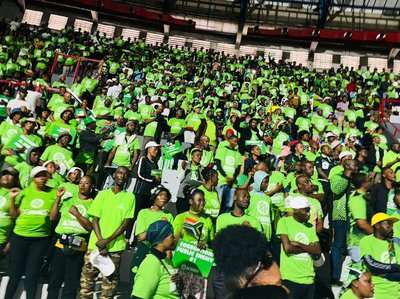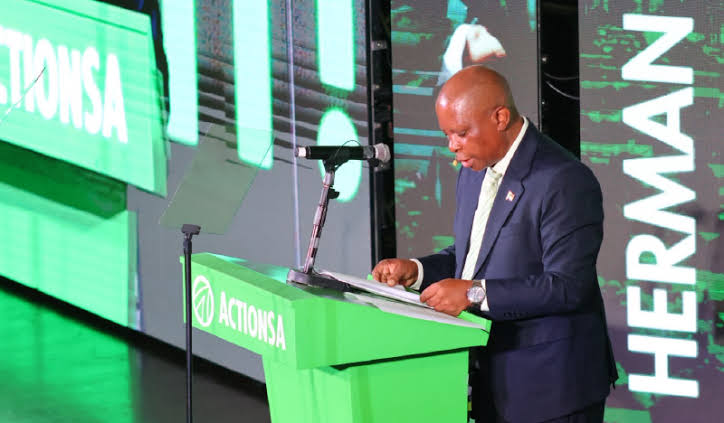
JOHANNESBURG, Saturday 26 September 2026 — ActionSA has launched its manifesto for the 4 November local government elections, promising to prioritise basic services, municipal finances, professional administrations, community safety and local economic development while ruling out pre-election coalition agreements.
Party president and Johannesburg mayoral candidate Herman Mashaba launched the programme in Johannesburg on Saturday as ActionSA seeks to expand its municipal representation and position itself as a significant participant in several potentially hung councils.
The manifesto sets out nine broad priorities ranging from water, electricity and roads to financial management, corruption, housing, economic development and cleaner municipalities.
ActionSA also clarified its approach to coalition government, saying it will not enter coalition agreements before voters go to the polls.
Any negotiations after the election would instead have to be based on a defined programme of government, clear responsibilities and mechanisms for accountability.
That position could become important in Johannesburg, Tshwane and Ekurhuleni, where fragmented electoral support makes outright majorities uncertain.
Basic services placed at centre of manifesto
ActionSA’s first priority is restoring what it describes as the basic functions of municipalities.
The party says councils should concentrate on reliable water and electricity, road maintenance, sewage infrastructure and refuse collection.
Mashaba argued that declining infrastructure and unreliable services were no longer confined to individual municipalities.
He presented the election as an opportunity for ActionSA to apply the municipal approach it advocates across a wider group of councils.
The claims form part of the party’s election platform and will be tested against its performance where it currently participates in government and against the records and proposals of competing parties.
Party proposes tighter financial controls
Municipal finances form another major component of the programme.
ActionSA says councils under its influence should adopt fully funded budgets, improve revenue collection and metering, strengthen billing systems and implement financial recovery plans where municipalities are in distress.
The party also proposes reducing political staffing within municipalities.
Appointments should instead be based on qualifications, competence, experience and merit, according to the manifesto.
Municipal officials would be subject to defined performance standards and accountability measures where they fail to deliver.
The proposals respond to financial and administrative problems identified repeatedly by the Auditor-General across local government, although their effectiveness would depend on implementation by individual councils.
Tender transparency and whistle-blower protection promised
ActionSA says it would increase transparency around municipal procurement and contracts and investigate suspicious transactions.
It also promises greater protection for whistle-blowers.
Mashaba linked corruption directly to service delivery, arguing that money lost through fraudulent or inflated contracts reduces the funding available for infrastructure and municipal services.
The manifesto does not itself create new investigative powers for municipalities.
Councils would still have to operate within national procurement, criminal-justice and municipal-finance legislation and work with institutions such as SAPS and other investigative authorities where appropriate.
Municipal policing and infrastructure crime targeted
Community safety forms another pillar.
ActionSA proposes increasing municipal law-enforcement capacity and directing greater attention towards infrastructure theft, illegal electricity connections, hijacked buildings and criminal syndicates operating within cities.
The party also links immigration enforcement to municipal governance.
It says municipalities should use the powers lawfully available to them to address illegal immigration while cooperating with the Department of Home Affairs and South African Police Service where enforcement falls within national jurisdiction.
Immigration has been a prominent component of ActionSA’s political platform since its formation.
Municipal governments, however, do not control national immigration policy, meaning many of the enforcement measures advocated by the party would require cooperation with national authorities.
Business and jobs feature in local-government offer
ActionSA also wants municipalities to reduce regulatory barriers for businesses.
Its manifesto proposes defined turnaround times for municipal approvals, improved access to opportunities for small businesses and measures aimed at revitalising central business districts and town centres.
The party says local governments should expand skills and work opportunities for young people.
Municipalities have limited direct control over national employment policy, but their planning, infrastructure, zoning, procurement and licensing decisions can affect local investment and business activity.
The party is therefore presenting better municipal administration as part of its employment strategy rather than promising that councils can independently solve unemployment.
Housing plan includes title deeds and municipal land
Housing and informal settlements are another priority.
ActionSA says informal settlements should be upgraded where appropriate and promises faster delivery of title deeds.
It also wants municipalities to make greater use of available municipal land for affordable housing.
The manifesto calls for improved public-transport connections and maintenance of libraries, parks, sports facilities and other community infrastructure.
Environmental proposals include stronger action against illegal dumping, expanded recycling and cooperation with waste pickers and businesses to reduce pressure on landfill sites.
No pre-election coalition deals
ActionSA’s coalition position is particularly consequential because of the likely composition of several councils after 4 November.
The party says it will not enter pre-election coalitions.
Mashaba said any coalition formed afterwards should be based on a clear programme of government rather than the distribution of political positions.
That leaves ActionSA free to negotiate with other parties once voters have determined the balance of seats.
It also means voters will go into the election without knowing definitively which parties ActionSA might help place in government in a hung council.
Mashaba has previously said the party accepts that coalition politics has become a feature of South African government and has indicated a willingness to work with other parties subject to policy conditions.
Saturday’s manifesto places the emphasis on the structure of any eventual agreement rather than naming preferred partners.
Johannesburg result could make ActionSA pivotal
The coalition question is especially important in Johannesburg.
Mashaba is seeking to return to the mayoralty he held between 2016 and 2019, when he governed the city as a DA mayor with support from several opposition parties.
He subsequently left the DA and founded ActionSA.
Current polling indicates that Johannesburg could again produce a hung council, with the ANC and DA competing for first place and ActionSA among the parties capable of winning a significant bloc of seats.
That creates several possible post-election configurations.
ActionSA could seek to lead a government itself, support another mayoral candidate through a coalition agreement, or remain in opposition.
The final decision would depend on the election result and negotiations after 4 November.
Tshwane provides ActionSA with governing record
ActionSA is also campaigning on its role in Tshwane, where Nasiphi Moya serves as executive mayor.
Moya addressed Saturday’s manifesto launch and presented Tshwane as evidence that the party can participate in municipal government rather than operate only as an opposition organisation.
The party’s record in the capital will consequently form an important part of the campaign.
Opposition parties will scrutinise service delivery, finances and coalition decisions under Moya, while ActionSA is likely to use improvements it attributes to her administration as evidence for its national municipal offer.
The Tshwane government itself depends on cooperation between multiple parties, underscoring the significance of ActionSA’s insistence that coalition arrangements require defined responsibilities and accountability.
Manifesto launches as campaign enters final stretch
ActionSA is contesting dozens of municipalities in its second local government election.
It won representation in Johannesburg, Tshwane, Ekurhuleni and several other councils in 2021 and has subsequently expanded through by-elections, defections and its Green Umbrella initiative involving smaller community-based political organisations.
The party now faces the test of converting that organisational expansion into votes.
Its strongest potential influence may not depend solely on finishing first.
In fragmented councils, even a party finishing third or fourth can become important to the election of a mayor and the formation of a governing majority.
Saturday’s manifesto establishes the programme ActionSA says it would take into those negotiations.
The decisive question after 4 November will be how much electoral leverage voters give it — and which parts of the nine-point programme the party treats as non-negotiable when coalition talks begin.