JOHANNESBURG, Tuesday 22 September 2026 — The DA has filed an urgent Electoral Court application challenging the use of single-name proportional-representation candidate lists by ActionSA, the EFF, MK Party and GOOD, asking the court to determine whether parties may deliberately leave potential council candidates unnamed until after the 4 November local government elections.
The filing moves a dispute over the interpretation of municipal electoral law from political argument into formal litigation less than seven weeks before voting.
The DA said on Tuesday that its application challenges the deliberate submission of PR lists containing only one candidate by the four parties and asks the Electoral Court to determine the legality and constitutionality of using post-election supplementation as an electoral strategy.
No court ruling has been made on the merits of the DA’s argument.
The affected parties remain entitled to oppose the application and advance their own interpretation of the legislation.
Single-name lists appear across major metros
The dispute emerged after the IEC published the final certified candidate lists for the municipal elections.
EWN reported last week that ActionSA, the EFF, MK Party, GOOD and several other parties had submitted single-name PR lists in municipalities where they could potentially win more than one proportional seat.
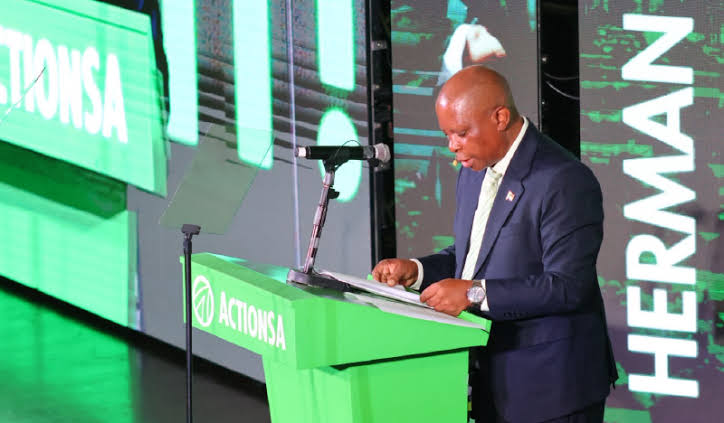
In Johannesburg, ActionSA’s PR list contains only party president and mayoral candidate Herman Mashaba.
The EFF has listed Tlaleng Mofokeng as its sole Johannesburg PR candidate, while MK Party has listed Bongani Baloyi.
Similar strategies appear in other metros.
ActionSA listed Dereleen James as its sole Cape Town PR candidate and incumbent mayor Nasiphi Moya as its only Tshwane PR candidate.
The EFF listed Nontando Nolutshungu in Cape Town and Omphile Maotwe in Tshwane, while MK Party listed Ncumisa Mahangu and Nkele Matime respectively.
The existence of single-name lists is not itself proof that electoral law has been breached.
That is the issue the DA is asking the Electoral Court to determine.
DA asks court to rule on deliberate supplementation
The DA’s argument centres on provisions allowing parties to supplement PR lists where they win more seats than they have candidates available to fill.
The party accepts that the law contains a mechanism for addressing a candidate shortfall after an election.
Its case is that the mechanism was intended for unexpected circumstances rather than allowing parties to deliberately submit incomplete lists before voting and select additional councillors after the results are known.
DA Federal Council chairperson Ashor Sarupen said the party wants the court to determine whether the supplementation provision can lawfully be used as a planned electoral strategy.
According to the DA, voters should be able to see the identities and ranking of potential PR councillors before casting their ballots.
That is the DA’s legal position and has not yet been endorsed by the Electoral Court.
ActionSA says strategy is deliberate
ActionSA has publicly confirmed that it intentionally submitted only one name on its Johannesburg PR list.
In a response reported by EWN on Monday, the party said it planned to supplement the list according to the number of seats it wins after the election.
ActionSA said the process would allow it to assess the performance of ward candidates during the campaign.
The party said candidates had been given key performance indicators by its regional and provincial structures and that factors including skills and representation would be considered when determining who should occupy additional PR seats.
ActionSA maintains that the IEC’s processes allow parties to supplement their lists where the number of successful PR seats exceeds the number of candidates originally submitted.
The DA’s application directly challenges whether that mechanism may lawfully be used deliberately in this way.
Election expert disputes DA interpretation
Former IEC vice-chairperson and election-management specialist Terry Tselane has publicly offered an interpretation that differs from the DA’s.
Tselane told 702 that the Municipal Structures Act provides a process where the chief electoral officer must notify a party if its list contains fewer candidates than the number of seats to which the party becomes entitled.
Under that interpretation, the party would then have two days to provide sufficient additional eligible candidates.
Tselane said the legislation does not require a political party to submit as many candidates as there are available council seats before an election.
He argued that the statutory supplementation mechanism could therefore apply when a party receives more seats than its initial list can fill.
His interpretation is not a court ruling.
The Electoral Court will now have an opportunity to consider the competing readings of the legislation.
2021 amendments form part of dispute
The disagreement also concerns the effect of amendments to the Municipal Structures Act adopted in 2021.
The DA argues that those amendments were intended to prevent parties from withholding candidate names before an election and subsequently filling PR seats once the results were known.
Tselane disputes that interpretation.
He said the amendments regulate the procedure and timeframe for supplementing an insufficient list rather than prohibiting parties from initially submitting fewer candidates than the number of seats they might ultimately receive.
The court will therefore have to interpret both the wording and purpose of the relevant provisions.
Johannesburg could be particularly affected
The dispute carries particular significance in Johannesburg because of the number of parties contesting the metro and the likelihood that several will obtain multiple proportional-representation seats.
The IEC’s certified lists show that 80 parties are contesting Johannesburg’s PR ballot, the highest number of any metro.
ActionSA already holds substantial representation in the outgoing Johannesburg council and is campaigning under Mashaba to increase its representation.
If it wins multiple PR seats while maintaining only Mashaba on its pre-election PR list, the supplementation mechanism at the centre of the court dispute would become necessary to fill the remaining seats.
The same issue could arise for other parties using single-name lists.
Tshwane and Cape Town also affected
The litigation is not limited to Johannesburg.
Single-name lists have also been submitted in Tshwane, Cape Town and other municipalities.
That means an Electoral Court interpretation could determine how affected parties fill proportional seats nationally after the election.
The EFF is contesting 4,484 of South Africa’s 4,485 wards and all 257 municipalities, while ActionSA and MK Party have also submitted thousands of ward candidates nationally.
The DA argues that the scale of their ward participation demonstrates that the short PR lists are intentional rather than the result of an inability to identify candidates.
That remains part of the applicant’s case rather than an established judicial finding.
Case differs from ANC candidate deadline dispute
The new litigation is separate from the ANC’s dispute with the IEC over 181 candidates excluded from the certified lists.
The ANC argued that candidate information had been uploaded before the nomination deadline but that final electronic submission had not been completed because of difficulties with the IEC system.
The Electoral Court rejected that application.
The current DA case does not concern a missed deadline.
Instead, it concerns candidate lists that were submitted and certified on time but contain fewer names than the parties could require if they obtain multiple PR seats.
The distinction will be central to the new proceedings.
Coalition formation could be affected
The timing of candidate supplementation could also matter in councils where no party wins a majority.
Once election results are declared, parties typically begin negotiations over the election of mayors, speakers and other council office-bearers.
PR councillors form part of the voting strength available to parties during those negotiations.
If parties with single-name lists must supplement them after results are known, the identities of some councillors could be determined during the period in which coalition discussions are beginning.
The DA argues that those potential representatives should be disclosed before voting.
ActionSA’s stated position is that its post-election process allows candidate performance and representation to be considered after voters have determined how many seats the party receives.
The Electoral Court will have to determine the legal question rather than the political merits of either approach.
Electoral Court timetable now awaited
The next procedural step will be confirmation of the timetable for the urgent application and responses from the affected parties and, where applicable, the IEC.
The DA has asked the court to determine whether deliberate reliance on post-election list supplementation complies with electoral law and constitutional requirements.
Until judgment is delivered, the IEC’s certified lists remain the operative candidate lists for the 4 November election.
The case could provide an important interpretation of how South Africa’s municipal proportional-representation system should operate when a party deliberately submits fewer candidates than the number of seats it could reasonably expect to win.
With voting scheduled for 4 November, the court’s ruling could determine whether ActionSA, the EFF, MK Party and GOOD may retain their current strategy or must alter how potential PR councillors are identified before voters go to the polls.