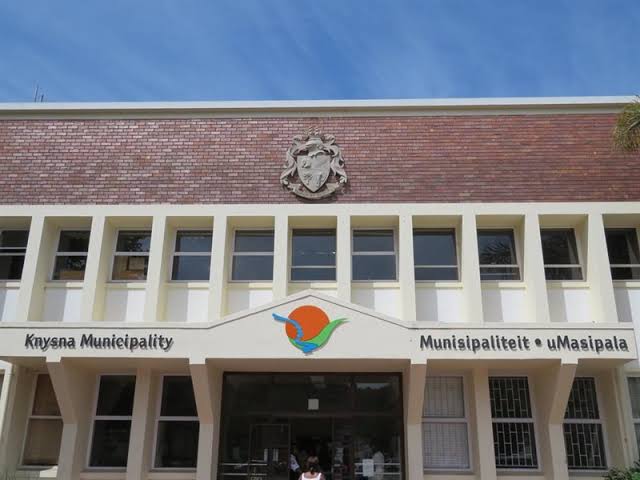
KNYSNA, Thursday 24 September 2026 — Knysna remains without an elected mayor or functioning mayoral committee after a special council meeting intended to replace former mayor Thando Matika collapsed because councillors failed to establish a quorum, deepening political uncertainty six weeks before South Africa’s local government elections.
Only nine councillors attended Wednesday’s special sitting, two fewer than the 11 required for the 21-seat council to proceed.
Speaker Mark Willemse said the meeting had been “purposely collapsed” and has referred information about repeated councillor absenteeism to Western Cape Local Government MEC Anton Bredell.
The council itself remains legally constituted and Deputy Mayor Morton Gericke can exercise mayoral executive authority in an acting capacity, but the mayoral committee was automatically dissolved when Matika ceased to be mayor.
No new date has been announced for electing his successor.
Matika lost office after appearing on SACP candidate list
The political disruption follows the ANC’s decision to remove Matika after the Electoral Commission’s final candidate information showed him contesting the 4 November election under the South African Communist Party banner.
Matika had been serving as an ANC councillor and executive mayor.
The ANC said his decision to stand for another political organisation was his democratic right but was incompatible with continuing to occupy a council seat obtained through the ANC.
Once Matika ceased to be a councillor, he could no longer serve as executive mayor.
His departure automatically dissolved the mayoral committee.
The development is one of the clearest municipal consequences yet of the SACP’s decision to contest the 2026 local government elections independently of its longstanding alliance partner.
ANC reduced from seven seats to three serving councillors
The turmoil extends beyond Matika.
The ANC entered the current council term with seven seats but is now down to three serving councillors, with four council vacancies.
Ward 3 councillor Lukhanyiso Nohana has also been removed after appearing as an SACP candidate and is challenging his expulsion from the ANC in court.
Ward 7 councillor Mboneli Khumelwana has also left the council amid the political realignment, while another vacancy followed the death of former mayor Aubrey Tsengwa.
The resulting council currently has eight DA councillors, three ANC councillors, two each from the Knysna Independent Movement and Patriotic Alliance, and one each from the EFF and Plaaslike Besorgde Inwoners, alongside four vacancies.
That arithmetic makes attendance particularly important.
With four vacant seats, relatively few additional absences can prevent the council from reaching the quorum needed to conduct business.
All three remaining ANC councillors missed sitting
The ANC’s three remaining councillors — Kay Andrews, Russel Arends and Pindile Petros — were absent from Wednesday’s sitting.
Patriotic Alliance councillor Beauty Charlie was also absent.
DA councillor Hilton Stroebel, EFF councillor Neil Louw and PA councillor Richard Kakora had requested leave because of illness, while Gericke, of the PBI, submitted an apology.
Willemse said repeated absenteeism at special council meetings had become a concern.
He said an earlier sitting had also been disrupted after councillors requested a caucus break but did not return to the chamber.
The speaker has sent information concerning the missed meetings to Bredell.
Councillors who repeatedly fail to attend meetings without appropriate grounds can face disciplinary processes under municipal rules and the councillor code of conduct.
Speaker says meeting was deliberately collapsed
Willemse’s assertion that Wednesday’s sitting was “purposely collapsed” adds a new dimension to the governance dispute.
It is his characterisation of the circumstances rather than an independently established finding about individual councillors’ intentions.
Bredell confirmed that the council itself had not collapsed.
“The council has not collapsed. The scheduled sitting could not proceed because certain councillors failed to attend, leaving the chamber without the required quorum,” he said.
That distinction matters.
Knysna still has a functioning municipal council capable of taking decisions when sufficient councillors attend.
What it currently lacks is an elected executive mayor and the mayoral committee that normally provides political oversight of municipal departments.
ANC says coalition agreements remain intact
The ANC maintains that the political upheaval has not ended its coalition arrangements.
ANC Western Cape spokesperson Sifiso Mtsweni acknowledged that the loss of Matika and other councillors had destabilised the municipality but said existing coalition agreements remained in place and the municipality continued to function.
The ANC has governed with support from smaller parties including the EFF and PBI.
However, Wednesday’s failure to elect a mayor illustrates how fragile that arrangement has become as the November election approaches.
A coalition agreement has limited practical effect if participating parties cannot consistently assemble enough councillors to conduct council business.
SACP candidacy reshapes local ANC politics
The immediate crisis is inseparable from the ANC-SACP relationship.
The SACP historically contested elections through the ANC as part of the Tripartite Alliance but is standing independently in the 2026 municipal elections.
Matika and Nohana are among sitting ANC representatives who have aligned themselves electorally with the SACP.
The SACP is contesting in 204 municipalities nationally, according to final IEC candidate information reported by The Herald.
Knysna therefore offers an early indication of how independent SACP participation can affect existing ANC representation before voters even reach the polls.
The consequences are unusually direct: councillor departures have changed the balance and functioning of an incumbent municipal government.
Knysna enters final campaign without settled executive
The timing increases the significance of the impasse.
South Africans vote in municipal elections on 4 November, meaning the current council has only about six weeks remaining before voters determine a new composition.
Knysna has experienced repeated political instability during the current term and was the subject of an unsuccessful Western Cape government attempt to dissolve the council in 2025.
The National Council of Provinces rejected that intervention.
The latest disruption does not amount to the legal collapse of the municipality, but it again raises questions about whether Knysna’s fragmented political leadership can provide stable executive oversight.
The immediate next step is another council sitting to elect a mayor.
No date had been announced by Thursday evening.
If councillors again fail to establish a quorum, the municipality could enter an increasingly large portion of the remaining pre-election period without an elected executive mayor and mayoral committee.