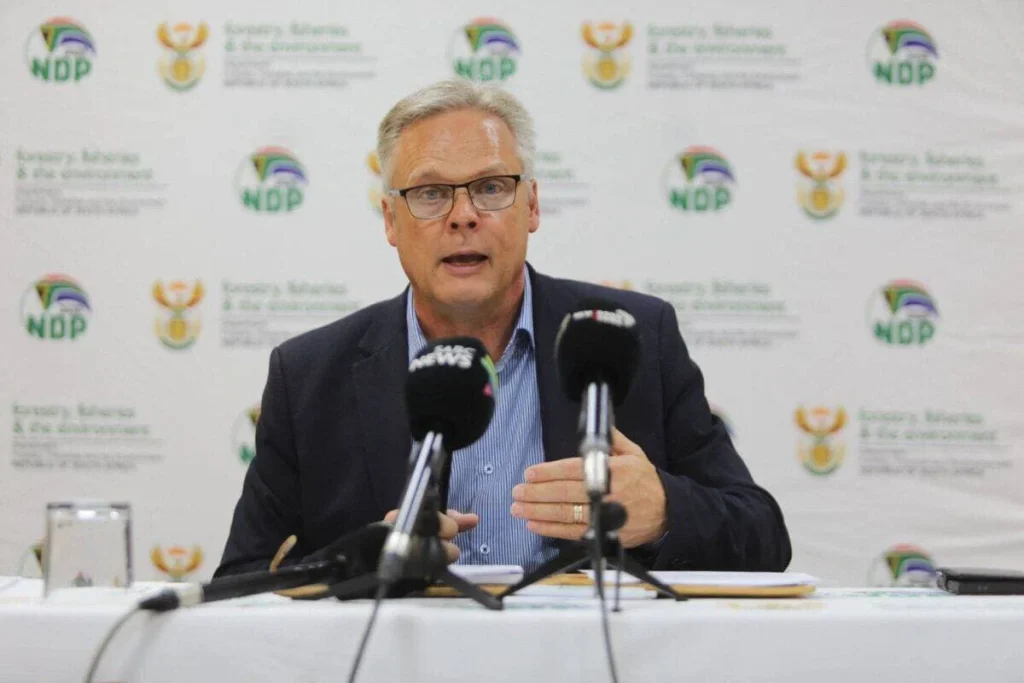
CAPE TOWN, Friday 11 September 2026 — Finance Minister Enoch Godongwana says the South African Revenue Service has identified the minibus-taxi and e-hailing industries as priority sectors for expanding tax compliance, as government seeks to broaden the revenue base without relying primarily on higher tax rates for already compliant taxpayers.
Godongwana disclosed the strategy in a written parliamentary reply, saying SARS was focusing on registration, return filing and payment in parts of the economy where compliance remains comparatively low.
The policy does not constitute a new tax on taxi operators or e-hailing drivers. Rather, SARS intends using existing tax laws, data and enforcement powers to identify businesses and operators that should already be registered or paying tax.
The intervention is potentially significant because minibus taxis provide the majority of daily public transport trips for many South Africans, while e-hailing has become an increasingly important part of the urban transport economy.
Informal economy identified for tax-base expansion
Godongwana said SARS was seeking to widen the tax base by improving compliance in the informal economy rather than concentrating additional revenue measures on taxpayers already inside the system.
“SARS continues to broaden the tax base by improving registration, filing and payment, where tax compliance remains low,” the minister said in the parliamentary reply quoted by several news organisations.
The work includes informal businesses as well as the taxi industry.
According to Godongwana, SARS has registered 21,890 previously unregistered taxpayers in the informal economy since the 2024/25 financial year, generating approximately R314 million in additional revenue.
Those figures cover the wider informal-economy compliance programme and should not be interpreted as revenue collected specifically from taxi operators.
Taxi and e-hailing sectors become priority areas
Godongwana specifically identified taxis and e-hailing services as areas where SARS intends intensifying compliance work.
“The taxi industry, including e-hailing services, has been identified as priority sectors in SARS’ informal economy and compliance work,” he said.
SARS plans to use risk assessments, available data and targeted interventions to identify potentially unregistered or non-compliant taxpayers.
The revenue service will also continue taxpayer education aimed at helping operators understand registration, filing and payment requirements.
That distinction is important because the strategy includes both voluntary compliance measures and enforcement, rather than treating every participant in the sector as non-compliant.
Third-party and transactional data will play larger role
A central part of the strategy involves using third-party and transactional information.
Godongwana said SARS would use available data to identify businesses or individuals whose economic activity indicates that they may have tax obligations that are not being met.
The growth of digital payments and app-based transport makes this particularly relevant to e-hailing.
Transactions involving e-hailing platforms typically generate considerably more electronic information than traditional cash-based informal businesses, potentially giving SARS greater visibility over revenue flows.
What information may legally be obtained, how it is matched to individual taxpayers and whether a person ultimately owes additional tax will depend on existing tax legislation and each taxpayer’s individual circumstances.
Compliance campaign does not mean every driver owes income tax
The announcement should also not be interpreted as meaning that every taxi or e-hailing driver will automatically face a tax bill.
South African income tax liability depends on factors including taxable income, allowable deductions and applicable thresholds.
A driver employed by a taxi owner is also in a different tax position from a vehicle owner operating a transport business.
Similarly, individual e-hailing drivers may operate through different employment, contractor or business structures.
SARS’s immediate objective is therefore to improve registration and declaration of economic activity, after which ordinary tax rules determine what, if anything, is payable.
Broader effort aimed at spreading tax burden
The parliamentary reply was given in response to questions about how government intends expanding the tax base instead of repeatedly increasing the burden on existing taxpayers.
South Africa relies heavily on a comparatively concentrated group of personal-income-tax and corporate taxpayers, making improvements in compliance an important part of government’s revenue strategy.
Bringing previously unregistered economic activity into the system can increase collections without changing headline tax rates.
Godongwana said SARS was also working with Statistics South Africa and other institutions to develop clearer ways of distinguishing and measuring formal, informal and illicit economic activity.
The distinction is important: operating informally is not itself equivalent to conducting illicit activity.
SARS also intensifies illicit-finance enforcement
Alongside the informal-sector programme, SARS is increasing enforcement against tax evasion, customs fraud, money laundering, corruption and other illicit financial activity.
Godongwana said SARS recorded 10,142 customs seizures worth R6.3 billion during the 2024/25 financial year.
Another R6.1 billion was recovered in matters associated with VAT fraud and illicit gold trading, according to the parliamentary response.
Those operations are separate from the taxi-sector compliance initiative, although both form part of SARS’s wider effort to reduce revenue leakage.
Taxi industry presents unusual compliance challenge
The minibus-taxi industry occupies an unusual place in South Africa’s economy.
It provides a critical public-transport service but consists largely of privately owned businesses ranging from individual vehicle owners to operators with significant fleets.
Much of the sector has historically relied on cash transactions, which can make turnover harder to verify than economic activity processed through conventional banking or payroll systems.
The industry is also organised through taxi associations rather than a single national corporate structure.
That means SARS will need to distinguish between vehicle owners, associations, drivers, employees and other businesses involved in the industry when applying ordinary tax rules.
E-hailing presents a different model because digital platforms produce detailed electronic records, although questions around driver costs, commissions and business expenses will remain relevant to assessments.
Tax compliance could become politically sensitive
Any significant intervention in the taxi industry also carries broader political and policy implications.
Minibus taxis move millions of commuters and taxi associations have considerable organisational influence in communities across the country.
Government departments simultaneously regulate the sector, provide operating subsidies or incentives in some circumstances and rely on operators as a fundamental part of the public-transport network.
SARS will therefore have to enforce tax legislation without disrupting transport services or creating the impression that legitimate operating costs and business structures are being ignored.
Godongwana’s parliamentary response indicates that education and simplified registration are intended to operate alongside enforcement.
Implementation now becomes the key test
The announcement does not set a single deadline after which all taxi or e-hailing operators will suddenly be audited.
Instead, it identifies the sectors as priority areas within an ongoing SARS compliance programme.
The practical significance will become clearer through the extent to which SARS deploys third-party data, conducts targeted audits and increases registrations and collections from the sectors.
For government, success would mean raising additional revenue by improving compliance rather than increasing rates on those already paying.
For taxi owners and e-hailing operators, it means that an area of the economy that has historically received less intensive tax scrutiny is likely to receive considerably more attention from SARS.