JOHANNESBURG, Friday 25 September 2026 — The government department coordinating South Africa’s response to gender-based violence says it cannot yet determine how much individual departments have reprioritised or spent on the crisis, ten months after GBV was classified as a national disaster and departments were instructed to redirect existing resources towards the response.
The Department of Women, Youth and Persons with Disabilities acknowledged that spending is difficult to quantify because departments do not necessarily maintain dedicated GBV budget programmes against which expenditure can be tracked.
The disclosure comes amid renewed scrutiny of the state’s response following the discovery of nine murdered women in Ekurhuleni since July and President Cyril Ramaphosa’s announcement that he will address the nation on government’s GBV interventions.
The issue is not evidence that departments have spent nothing.
It is an accountability problem: the coordinating department currently cannot provide a consolidated figure showing how much was redirected, where it was spent or what interventions that expenditure financed.
Disaster classification did not automatically release emergency money
The distinction between declaring GBV a national disaster and declaring a national state of disaster is important.
The classification did not automatically create a new emergency funding pool.
Instead, departments were expected to reprioritise existing budgets towards interventions responding to gender-based violence and femicide.
That approach meant spending would occur across several departments rather than through a single national GBV appropriation.
Ten months later, however, government has not produced a consolidated accounting of those allocations.
Coordinating department says spending is difficult to track
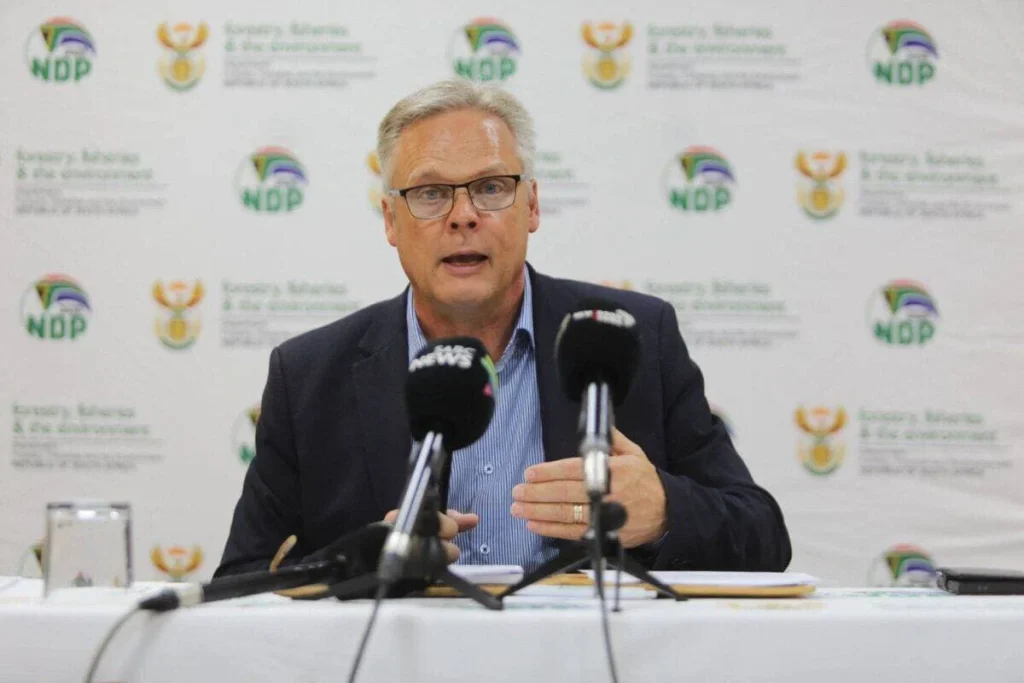
Department of Women, Youth and Persons with Disabilities spokesperson Cassius Selala told EWN that the department does not know precisely how much each department has allocated or what every allocation has funded.
He said part of the difficulty is that departments incorporate GBV-related work into broader programmes rather than maintaining separately identifiable GBV budget lines.
Basic Education, for example, may address gender-based violence through educational programmes without having a programme explicitly labelled “gender-based violence and femicide”.
That makes it difficult to extract a single spending figure from departmental budgets.
Selala maintained that interventions are taking place despite the absence of consolidated financial data.
Coordination role increases accountability questions
The Department of Women does not implement every government GBV programme itself.
Its role includes coordinating work undertaken across government.
It also co-chairs the interministerial structure responsible for the national response.
That coordinating role makes the absence of consolidated spending information particularly significant.
Without common reporting standards, government cannot easily demonstrate how much money was redirected after the disaster classification or compare spending with measurable outcomes.
It also makes parliamentary oversight more difficult.
Parliament plans to scrutinise allocations
The funding question has already attracted attention in Parliament.
Committees intend examining the money set aside or redirected towards government’s GBV response and how departments are accounting for its use.
That oversight could force departments to distinguish more clearly between ordinary programmes that incidentally address GBV and expenditure specifically reprioritised because of the national disaster classification.
The central question is therefore not merely how much government says it is doing.
It is whether Parliament and the public can trace commitments through departmental budgets to actual programmes and outcomes.
Ekurhuleni killings have intensified scrutiny
The disclosure comes as government faces acute public pressure over the killings of women in Ekurhuleni.
Police have confirmed that nine women’s bodies have been discovered across the metro since July.
Investigators have not established that all nine deaths are connected, and police have cautioned against concluding that a serial offender is responsible without evidence.
The cases have nevertheless intensified demands for government to demonstrate what changed after GBV received national-disaster classification.
Ramaphosa said during Thursday’s Heritage Day address that he would address the nation in the coming days on both the Ekurhuleni investigation and the government’s broader response to gender-based violence.
That announcement was covered separately by Mzansi Political Safari.
The funding-accountability disclosure is a distinct development because it concerns implementation of the national response rather than the criminal investigation itself.
Classification raised expectations of measurable action
Government’s decision to classify GBV as a national disaster was intended to recognise the scale and urgency of violence against women.
Such classifications also create expectations that government action will be coordinated across departments.
The difficulty now is demonstrating what that coordination produced.
If departments cannot report their reprioritised expenditure consistently, it becomes harder to determine whether the classification changed resource allocation in practice.
It also becomes difficult to assess whether departments complied equally with government’s instructions.
Spending alone will not establish effectiveness
A consolidated financial figure would still not, by itself, establish whether government’s GBV response is effective.
Departments would also need to show what the money funded.
Relevant outcomes could include improvements in police investigations, prosecution capacity, victim-support services, shelters, prevention programmes, school interventions, forensic services and court capacity.
Government would then have to measure whether those interventions produced results.
The current gap occurs one step earlier: the coordinating department cannot yet provide a complete financial picture of the resources being used.
Ramaphosa’s promised address raises stakes
Ramaphosa’s forthcoming national address is now likely to face scrutiny on both operational and financial grounds.
The president has promised an update on what government is doing to confront gender-based violence.
A comprehensive account would need to explain not only new interventions but how the existing national-disaster response has been implemented since its classification ten months ago.
That includes whether departments have complied with instructions to reprioritise resources and how government measures those allocations.
The Ekurhuleni killings have given that question immediate urgency.
Government’s challenge is therefore no longer simply to show that programmes exist.
It must increasingly demonstrate where resources went, what they delivered and whether the national-disaster classification changed the state’s response in measurable terms.