CAPE TOWN, Sunday 30 August 2026 — South Africa’s proposed law regulating municipal coalitions will not be completed before the 4 November local government elections, Parliament has confirmed, meaning newly elected councils — including potentially hung metropolitan councils — will initially have to form governments under the existing rules.
The Portfolio Committee on Cooperative Governance and Traditional Affairs reached that position after receiving its first substantive briefing on the Local Government: Municipal Structures Amendment Bill, commonly known as the Coalitions Bill.
Parliament said on Friday that the legislation still requires tagging, public participation, committee deliberations and processing through both Houses.
The Bill was formally introduced in Parliament on 18 August by Cooperative Governance and Traditional Affairs Minister Velenkosini Hlabisa.
It is intended to create a statutory framework for coalition governments following years of instability in municipalities where no party controls a majority.
That issue is particularly relevant to Johannesburg, Tshwane, Ekurhuleni and Nelson Mandela Bay, where coalition negotiations could again determine control after November.
More than 80 municipalities produced hung councils following the 2021 elections, compared with 29 in 2000.
The Bill proposes requiring written coalition agreements and making them publicly accessible.
Coalition agreements would have to be submitted to the municipal manager and the provincial MEC responsible for local government and published in the Provincial Gazette.
It would also extend the period available to constitute municipal governance structures from 14 to 30 days.
That change is intended to give parties more time to negotiate governing arrangements after elections rather than requiring coalitions to be assembled within two weeks.
Another provision would restrict repeated attempts to remove specified municipal office-bearers.
The Bill proposes a 12-month limitation on such motions while retaining grounds for removal including financial misconduct and criminal conviction.
Rapid motions of no confidence have played a central role in instability in several coalition municipalities during the current term.
Johannesburg has had multiple mayors since the 2021 election as shifting alliances repeatedly changed control of the council.
The Bill would also strengthen municipal public accounts committees and introduce clearer procedures when speakers or executive mayors leave office.
But one of the most politically contentious proposals considered during the development of the legislation is not contained in the Bill currently before Parliament.
Earlier versions proposed an electoral threshold that would prevent parties receiving less than a specified share of votes from gaining representation in municipal councils.
Parliament confirmed on Friday that those provisions were removed before the Bill was introduced because of constitutional concerns raised by the Office of the Chief State Law Adviser.
The omission is significant because an electoral threshold could substantially alter the composition of fragmented metropolitan councils.
Small parties holding one or two seats have repeatedly become decisive in coalition negotiations, particularly where the ANC, DA and other larger parties lack enough seats to form governments without several partners.
The Democratic Alliance has been among the strongest proponents of introducing a threshold.
DA MP George Michalakis has pursued separate legislation dealing with coalition government and electoral thresholds.
He has agreed to place his private member’s Bill on hold while Parliament considers how its provisions overlap with the government’s legislation.
The DA has nevertheless indicated that it will continue pressing for the threshold to be reconsidered.
News24 reported on Friday that the party wants a legal opinion on whether an electoral threshold can constitutionally be incorporated into the Coalitions Bill during Parliament’s deliberations.
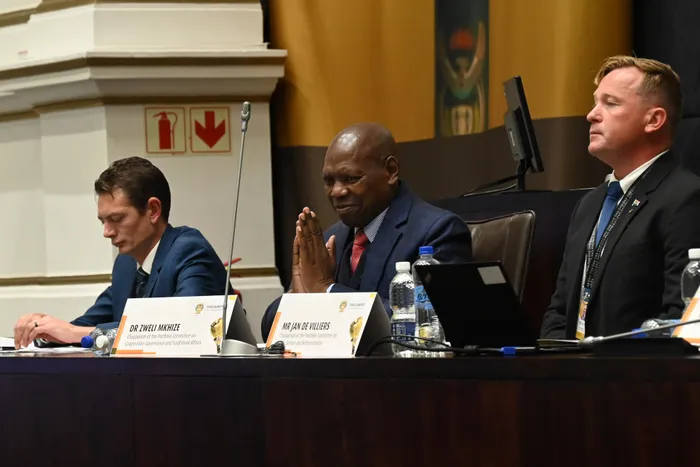
Committee chairperson Zweli Mkhize has also said the issue should not simply disappear because it was removed before introduction.
“It cannot just disappear because it did not make it into the Bill,” Mkhize said, according to Parliament’s official account of the committee proceedings.
The threshold debate creates a constitutional tension between two objectives.
Supporters argue that limiting entry by parties with extremely small vote shares could reduce council fragmentation and prevent single-seat parties from exercising disproportionate influence over the election and removal of mayors.
Critics have argued that thresholds could reduce political representation and exclude smaller community or local parties that have obtained sufficient support to qualify for seats under the existing proportional system.
The Office of the Chief State Law Adviser previously raised constitutional questions about applying such a threshold at municipal level.
Those questions will now return to Parliament.
Mkhize’s committee intends to obtain further legal advice before deciding whether threshold provisions should be reconsidered during deliberations.
Even if agreement is eventually reached, however, the legislation will not govern the November election itself.
Parliament’s Constitutional and Legal Services Office advised the committee that the legislation is likely to be classified as a Section 76 Bill because it affects provinces.
That would require consideration by both the National Assembly and National Council of Provinces.
Parliament said Section 76 Bills processed during the Sixth Parliament took an average of 34 months, while current joint rules generally provide up to 30 months for both Houses to complete such legislation unless an extension is agreed.
Parliamentary legal adviser Charmaine van der Merwe also cautioned against compressing constitutionally required public participation simply because parties regard the legislation as politically urgent.
“The courts have warned that the fact that the bill feels politically urgent does not mean that that allows us to actually reduce our timelines,” she told the committee.
That effectively ends earlier hopes that the new framework could be operational before voters elect municipal councils on 4 November.
The timing has potentially important consequences.
If Johannesburg, Tshwane, Ekurhuleni or other major municipalities again produce hung councils, parties will negotiate their initial governing arrangements under substantially the same legal framework that applied after the 2021 elections.
Coalition agreements will therefore not yet be statutorily mandatory, the proposed 30-day formation period will not apply and the new restrictions governing the removal of municipal office-bearers will not initially be available.
Small parties will also continue qualifying for council representation under the existing electoral formula because no new threshold will apply to November’s vote.
The practical effect could be particularly important in closely divided councils.
In Johannesburg, numerous small parties have participated in changing governing coalitions during the current term.
Similar coalition disputes have affected Ekurhuleni, Tshwane and Nelson Mandela Bay.
The possibility that the 2026 election produces additional hung councils makes the post-election period an immediate test of whether political parties can negotiate more durable arrangements without the statutory framework that government originally hoped to have in place.
The Bill could still affect councils during their five-year terms if it is enacted after the election.
Some provisions governing coalition agreements, motions of no confidence and municipal office-bearers could potentially become relevant to councils elected in November once the legislation takes effect, depending on the final wording and commencement provisions.
Parliament has not yet established a final timetable.
The committee secretariat will prepare a framework covering public participation, deliberations and proposed processing dates before members decide how to proceed.
For parties contesting the November election, however, one point is now substantially clearer: whatever coalition arithmetic voters produce in the eight metros and hundreds of other municipalities, the first negotiations over who governs them will take place without the new Coalitions Bill in force.