JOHANNESBURG, Saturday 29 August 2026 — The Gauteng government says it will consider absorbing 41 City of Johannesburg ambulances into the provincial emergency medical service after the vehicles became stranded by a long-running dispute over who may operate them, putting renewed focus on roughly R41 million in municipal assets ahead of November’s local elections.
The ambulances were bought by the City of Johannesburg Emergency Management Services in 2019 at a reported cost of about R1 million each, including equipment.
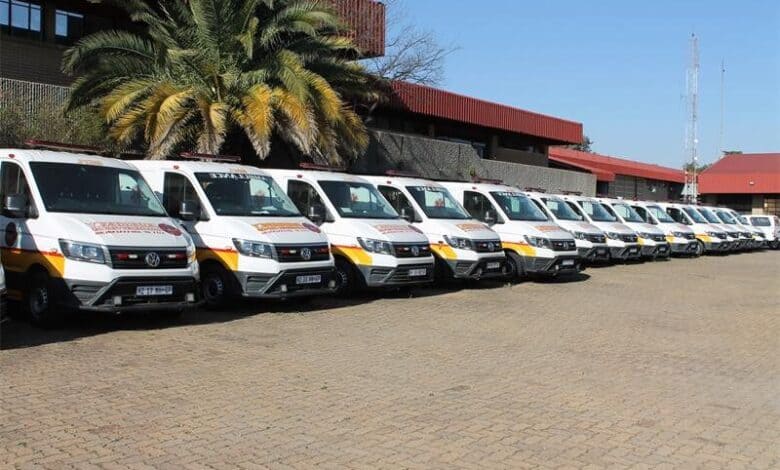
They are currently stored at the Florida Fire Station in Johannesburg.
The Gauteng government responded to the controversy on Saturday after reports highlighted that the fleet remained unavailable for normal ambulance operations.
It said the provincial government had not funded, procured or acquired the vehicles.
Instead, the dispute stems from the provincialisation of emergency medical services, a process under which the Gauteng Department of Health took responsibility for ambulance services previously operated by municipalities.
The province said it would now engage Johannesburg EMS about the future of the 41 vehicles, including the possibility of incorporating them into the provincial ambulance system.
That represents the clearest indication so far of a possible route for returning the vehicles to emergency-service use.
The dispute dates back years.
Johannesburg EMS spokesperson Robert Mulaudzi told the Roodepoort Record that the city ordered the ambulances in January 2019 and received them in June of that year.
Mulaudzi disputed descriptions of the vehicles as having been completely unused for six years, saying Johannesburg continued operating them for about two years after provincialisation before receiving legal advice that the service should stop.
According to Mulaudzi, residents were still approaching municipal fire stations for emergency medical assistance and the city had both trained personnel and the vehicles needed to respond.
The city eventually stopped using the ambulances after receiving legal advice about its authority to operate the service.
Johannesburg then sought permission to apply for a licence allowing its EMS to provide primary response, advanced life-support and supplementary services.
Mulaudzi said permission was granted towards the end of 2024 and an initial application was submitted to the Gauteng Department of Health early in 2025.
That application was rejected.
Johannesburg has since tried again.
The Gauteng government confirmed on Saturday that the city submitted another EMS operating-licence application in July 2026, covering six stations.
The application is being assessed and awaits a final decision by the Gauteng Health Department’s head of department.
Provincial authorities said ambulance services are subject to national requirements governing vehicle specifications, equipment, staffing and licensing under the Emergency Medical Services Regulations.
Gauteng said the provincialisation process was intended to establish a single, coordinated emergency medical system complying with those standards.
The episode nevertheless raises a broader public-finance and service-delivery question: how a fleet of expensive municipal emergency vehicles could remain substantially unavailable to residents for years while different spheres of government worked through regulatory and administrative arrangements.
The vehicles themselves appear to remain largely intact.
A recent inspection by the Roodepoort Record found the ambulances parked at Florida Fire Station and appearing relatively new, although some had flat tyres.
The current reporting does not establish their mechanical condition or what expenditure would be required to return every vehicle to active service after extended periods of limited use.
Nor does the available evidence establish that all 41 vehicles have been continuously stationary since 2020, given Johannesburg EMS’s account that they continued operating for approximately two years after provincialisation.
The distinction is important because the political dispute increasingly centres on both the use of public assets and responsibility for the administrative deadlock.
The issue has already entered provincial politics.
DA Gauteng MPL Alan Fuchs previously criticised the situation, arguing that the ambulances should have been serving communities rather than losing value while parked.
The provincial government, however, emphasised on Saturday that it was not responsible for Johannesburg’s original decision to purchase the fleet.
The dispute is particularly relevant in Johannesburg because service delivery has become one of the central battlegrounds in the campaign for control of the metro on 4 November.
Johannesburg has experienced repeated political leadership changes since the 2021 local government elections, while problems involving water, roads, electricity and municipal finances have become prominent issues in the current campaign.
The city’s emergency-services capacity now adds another example of the complicated division of responsibilities between municipal and provincial government.
The Constitution places health services principally within national and provincial competence, while municipalities retain responsibilities for functions including firefighting services and municipal health services.
The provincialisation of ambulances was intended to clarify that structure but, in the Johannesburg case, left the city owning vehicles it could no longer freely deploy as ambulances.
The political context is particularly sensitive because the ANC governs Gauteng provincially while Johannesburg is administered through a multiparty arrangement headed by ANC Mayor Dada Morero.
The Democratic Alliance, ActionSA, MK Party, EFF and other parties are challenging for control of the city in November.
The DA has selected Helen Zille as its mayoral candidate, ActionSA is campaigning behind former mayor Herman Mashaba and MK announced former Midvaal mayor Bongani Baloyi as its Johannesburg candidate on Friday.
The ANC is expected to choose its final mayoral candidate in September from a shortlist that includes Morero, Deputy Mayor Loyiso Masuku and Frank Chikane.
Against that backdrop, questions involving the effectiveness of Johannesburg’s municipal administration and the use of public assets are likely to receive heightened scrutiny during the campaign.
The immediate issue, however, remains administrative rather than electoral.
Gauteng Health must decide Johannesburg’s July licence application, while the provincial government and city must determine whether retaining the fleet within Johannesburg EMS or transferring the ambulances into the provincial service offers the quickest lawful route back into operation.
The province said it was committed to preventing the mismanagement of public resources and state assets while maintaining a compliant emergency medical system.
Its decision to consider absorbing the vehicles therefore creates a possible end to a dispute that has left a substantial fleet of emergency vehicles unavailable for its intended purpose.
Whether that happens before voters go to the polls on 4 November will depend on the outcome of the city’s licence application and the discussions now promised between the two spheres of government.