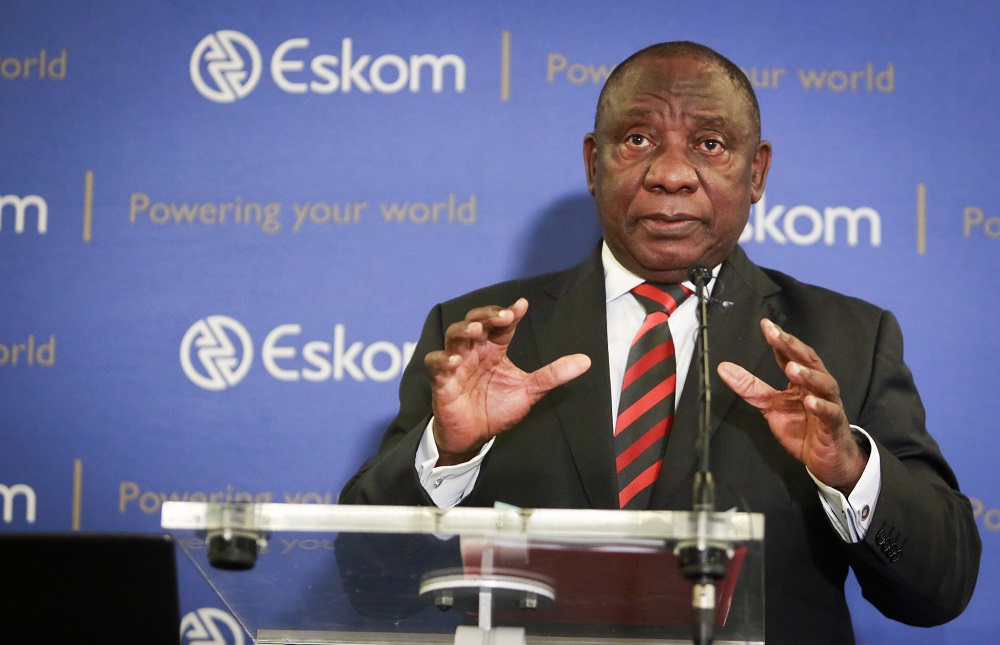
PRETORIA, Monday 31 August 2026 — President Cyril Ramaphosa has reaffirmed that South Africa will establish a fully independent, state-owned Transmission System Operator that owns and controls the country’s electricity transmission assets, after concerns over implementation prompted high-level talks with the Eskom board and organised labour.
The Presidency said on Monday that Ramaphosa met Mteto Nyati on Thursday, 27 August, as government moves into the next phase of restructuring the electricity sector.
The proposed Transmission System Operator, or TSO, would take ownership and control of transmission assets currently associated with Eskom and operate independently within the restructured electricity market.
Government says the model is intended to create equal access to the national transmission network for competing electricity producers and unlock private and public investment in new generation and grid infrastructure.
Ramaphosa stressed that independence would not mean privatisation.
The Presidency said the TSO would remain state-owned and would be regarded as a strategic national asset serving the public interest.
The clarification is politically significant because the structure and ownership of the transmission network have become a point of contention between government, Eskom, organised labour and business.
The National Union of Mineworkers has opposed the restructuring and announced plans earlier this month to challenge the process in court.
NUM president Phillip Vilakazi argued that restructuring could threaten Eskom and the broader economy, while general secretary Mpho Phakedi warned that it could ultimately result in job losses and privatisation.
Those claims represent the union’s position; government maintains that the proposed TSO itself will remain publicly owned.
Monday’s Presidency statement follows Ramaphosa’s recent engagement with NUM leadership over the proposed restructuring.
It also comes after disagreement over how transmission assets should be separated from Eskom.
Ramaphosa endorsed the first-phase report of the Eskom Restructuring Task Team on 31 July, setting the government’s preferred end-state as an independent Transmission System Operator separated from Eskom.
The task team includes representatives from the Presidency, National Treasury, the Department of Electricity and Energy, Eskom and the National Transmission Company South Africa.
Its work is now focused on how that structure should be implemented.
A central issue is the treatment of Eskom’s transmission assets and liabilities.
Eskom’s financial position, existing lender agreements and the ability of a new transmission entity to finance large-scale grid investment all have to be addressed during the separation.
Ramaphosa told Nyati that government would work with Eskom and other stakeholders to ensure the process preserves the utility’s financial position and allows the new operator to raise funding for transmission expansion.
The Presidency also committed to transparent engagement with Eskom’s lenders and funders.
The Eskom board has now publicly backed government’s policy direction.
Nyati confirmed the board’s support and committed Eskom to maintaining alignment with government as implementation proceeds, according to the Presidency.
A separate engagement between Eskom and Business Leadership South Africa on Monday produced a similar position.
Eskom and BLSA jointly supported the establishment of an independent Transmission System Operator that would hold the transmission assets, while stressing that the transfer must be carefully sequenced to protect Eskom’s finances, lender rights and energy security.
That represents an important narrowing of differences after weeks of public disagreement over the restructuring process.
The reform is considerably broader than the administrative separation of Eskom’s transmission division.
An independent system operator is intended to become a neutral platform through which Eskom generators and independent electricity producers compete for access to the grid.
South Africa has already established the National Transmission Company South Africa as an Eskom subsidiary.
The proposed TSO would go further by becoming independent of Eskom and assuming ownership and control of transmission infrastructure.
Government has previously targeted 31 December 2027 for establishing the independent operator.
The timetable matters because transmission capacity has become one of the biggest constraints on new electricity generation.
Large areas of the Northern, Western and Eastern Cape have limited grid capacity available for additional renewable-energy projects, even as private investment in generation has accelerated following reforms to the electricity market.
The government consequently sees transmission expansion as central to both energy security and economic growth.
Ramaphosa’s intervention also comes on the day Eskom announced its second consecutive annual profit.
The utility reported profit after tax of R30.3 billion for the financial year ended March 2026, up from a restated R14 billion in the previous year.
The stronger financial position increases the importance of how restructuring is implemented.
Government is attempting simultaneously to introduce competition into electricity generation, move control of the national grid into an independent operator and avoid undermining the financial recovery of Eskom.
Those objectives have sometimes produced tension between stakeholders over the pace and structure of reform.
Monday’s statements indicate that government, Eskom and organised business are now aligned on the intended destination: an independent operator owning the transmission assets, with the state retaining ownership.
The remaining disputes are therefore increasingly about implementation rather than the basic structure.
Organised labour remains the most significant source of opposition, particularly over employment, collective bargaining and concerns that restructuring could ultimately facilitate privatisation elsewhere in the electricity industry.
Any NUM court application could consequently create another test for one of the Ramaphosa administration’s largest structural reforms.
For now, the Presidency has made clear that those objections have not changed the government’s policy.
The next phase of the Eskom Restructuring Task Team will determine how the transmission assets, financing arrangements and institutional responsibilities are transferred — and whether government can establish the independent grid operator by its targeted end-2027 date without destabilising Eskom’s financial recovery.