PRETORIA, Tuesday 8 September 2026 — South Africa’s economy contracted by 0.2% in the second quarter of 2026, ending six consecutive quarters of expansion and adding pressure on the government to translate electricity, logistics and investment reforms into stronger economic growth.
Statistics South Africa said on Tuesday that real gross domestic product declined by 0.2% between the first and second quarters, after growing by a revised 0.4% in the first three months of the year.
Three of the country’s 10 major industries contracted during the quarter.
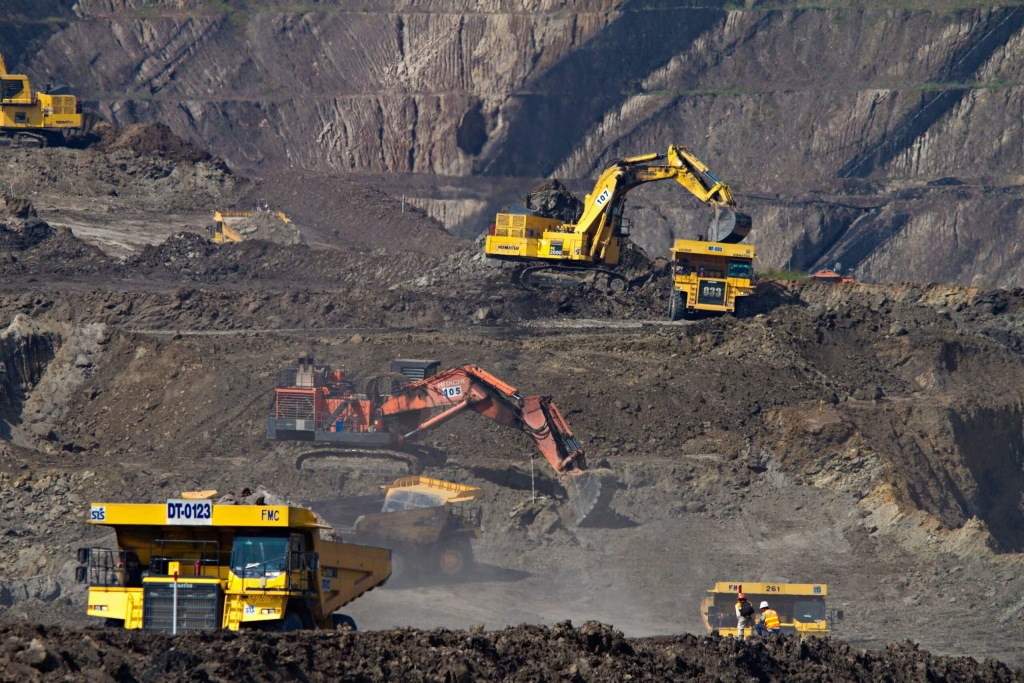
Trade, catering and accommodation fell 1.9%, manufacturing declined 1.8%, and mining and quarrying contracted 3%.
Trade and manufacturing each reduced overall GDP growth by 0.2 of a percentage point, while mining subtracted 0.1 of a percentage point.
The result puts renewed focus on the pace of South Africa’s economic recovery as the Government of National Unity approaches the second half of its term and political parties prepare for the 4 November local government elections.
Economic growth, employment and the performance of basic infrastructure have become recurring campaign issues across national and municipal politics.
Mining hit by broad production declines
Stats SA said weaker production of platinum-group metals, manganese ore, gold and iron ore drove the decline in mining.
Manufacturing weakness was similarly broad-based.
Seven of the sector’s 10 divisions contracted, with food and beverages, furniture and other manufacturing, and metal-related production among the largest negative contributors.
The trade sector was affected by weaker wholesale and motor trade as well as food-and-beverage activity.
South Africa has struggled for years to generate growth rates sufficient to make substantial inroads into unemployment, despite improvements in electricity availability and continuing efforts to reform freight rail, ports and other infrastructure.
Tuesday’s numbers indicate those improvements have not yet produced sustained expansion across the economy’s major productive sectors.
Household spending still grows
The economy was not uniformly weaker.
Household consumption rose 0.4% during the quarter, adding 0.3 of a percentage point to expenditure-side GDP.
Spending increased particularly on food and non-alcoholic beverages, recreation and culture, health and several other categories.
Government final consumption expenditure also increased by 0.4%.
Transport, storage and communication grew by 0.9%, while finance, real estate and business services expanded by 0.3%.
General government services increased by 1%, with Stats SA attributing the rise mainly to higher employee compensation in extra-budgetary and higher-education institutions and provincial government.
Personal services increased by 0.6%.
Agriculture recorded modest growth of 0.3%, supported by horticulture and field crops, while construction rose 0.4%.
Investment remains weak
Gross fixed capital formation declined by 0.2%, an important indicator because investment in machinery, buildings, infrastructure and other productive assets helps determine the economy’s future growth capacity.
Construction works fell 4%, while investment in transport equipment decreased by 3.4%.
The weakness comes as national government seeks to attract private investment into electricity, rail, ports, water and infrastructure.
President Cyril Ramaphosa’s administration has repeatedly identified higher fixed investment as necessary for increasing productivity, employment and long-term growth.
Tuesday’s release does not assess government policy or attribute the contraction to a single cause.
It instead shows that declines in several large productive industries outweighed growth elsewhere in the economy.
Imports outpace exports
Net trade was the largest negative component on the expenditure side of GDP.
Exports increased 0.9%, while imports rose substantially faster at 4.9%, resulting in net exports subtracting 1.1 percentage points from economic growth.
Imports were driven particularly by machinery and electrical equipment, mineral products, chemicals, plastics and related products.
Exports were supported by precious metals and stones, chemicals, agricultural products and paper products.
Inventory accumulation provided a partial counterweight, with businesses building inventories by a seasonally adjusted and annualised R8.8 billion during the quarter.
Economy still larger than a year ago
A single quarter of negative GDP growth does not constitute a recession.
South Africa would ordinarily need to record two consecutive quarters of contraction before being described as entering a technical recession.
The second-quarter decline follows first-quarter growth and therefore does not meet that definition.
The new data nevertheless reverse the momentum recorded during the preceding run of positive quarters.
That will sharpen scrutiny of the government’s growth strategy at a time when public finances remain constrained and unemployment remains one of South Africa’s most significant economic and political challenges.
The figures could also affect revenue expectations if slower economic activity persists, although one quarter of GDP data is insufficient on its own to determine the fiscal outlook.
Stats SA cautioned that the country’s national accounts are currently being rebased and benchmarked, with a new 2022 base year and additional datasets due to be incorporated.
The revised series is expected to be published in October 2026, meaning historical GDP estimates and the measured composition of the economy could change.
The next quarterly GDP release, covering July to September, is scheduled for 1 December 2026.
That report will show whether Tuesday’s contraction was temporary or whether economic weakness continued into the period immediately preceding the municipal elections.