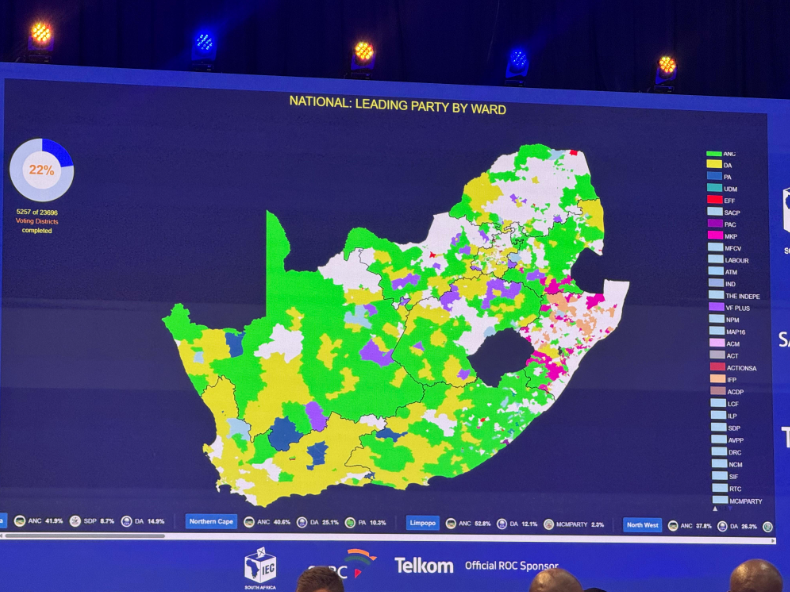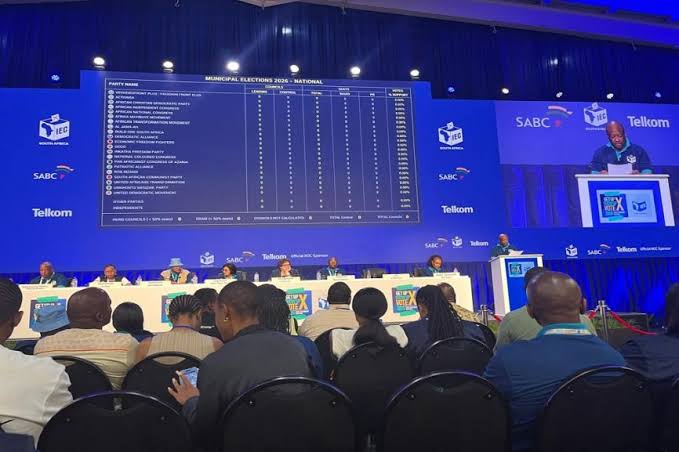
PRETORIA, Friday 6 November 2026 — At least 92 South African municipal councils are heading towards coalition negotiations after provisional election results showed that no political party had secured an outright majority in nearly two-thirds of councils with completed seat tallies.
IEC-derived figures published by ElectioMap at 14:33 on Friday showed 138 of the country’s 213 municipal councils with completed seat allocations, of which 92 had no majority party and 46 had an outright majority.
The figures illustrate the scale of coalition negotiations facing political parties following Wednesday’s local government elections, as counting continues in several municipalities, including the country’s eight metropolitan councils.
Most completed councils have no majority party
The 92 councils without a majority represent approximately 67% of the 138 councils for which seat allocations were available in the afternoon snapshot.
Earlier figures published by Reported, using The Outlier’s IEC-derived tracker, showed 88 hung councils among 129 completed local councils at 12:36 on Friday.
The changing totals reflect the addition of newly completed municipal counts as election results are processed.
A hung council arises when no party controls more than half the available seats, requiring parties to negotiate support arrangements or governing coalitions to elect municipal leadership.
Smaller parties could determine municipal leadership
The results indicate that smaller parties and independent councillors could play an important role in determining who governs municipalities where the largest party has fallen short of a majority.
Among the completed councils, several leading parties were just one seat short of securing outright control.
In Breede Valley in the Western Cape, the Democratic Alliance (DA) was allocated 20 of 41 seats, one short of the 21 required for a majority.
In Mandeni in KwaZulu-Natal, the uMkhonto weSizwe (MK) Party held 17 of 35 seats, while in uMzimkhulu the African National Congress (ANC) held 21 of 43 seats.
These narrow margins mean that agreements with smaller parties or individual councillors could determine the election of mayors and speakers.
ANC retains some outright municipal majorities
The earlier midday snapshot showed the ANC with outright majorities in 27 completed local councils, followed by the DA with nine.
The MK Party held outright majorities in three councils, while the Inkatha Freedom Party (IFP) and Rise Tsantsabane Communities each secured one.
These figures exclude councils whose seat allocations had not been completed at the time.
The ANC remained the largest party nationally in provisional vote totals, but its support had declined substantially compared with the 2021 municipal elections.
The DA was making gains in several metropolitan municipalities, while the MK Party was emerging as a significant force in KwaZulu-Natal.
Coalition negotiations to follow final results
Political parties will have to determine whether they can establish stable governing arrangements once the Electoral Commission of South Africa (IEC) formally declares the election results.
DA leader Geordin Hill-Lewis said on Friday that his party had begun contacting potential coalition partners and intended to publish agreements once concluded.
Under the municipal governance framework, newly elected councils must hold their first meetings within the prescribed period following the declaration of results.
Those meetings will determine the election of speakers, mayors and other political office-bearers.
With counting still under way, the number of councils requiring coalition arrangements could increase before the IEC announces the final results.