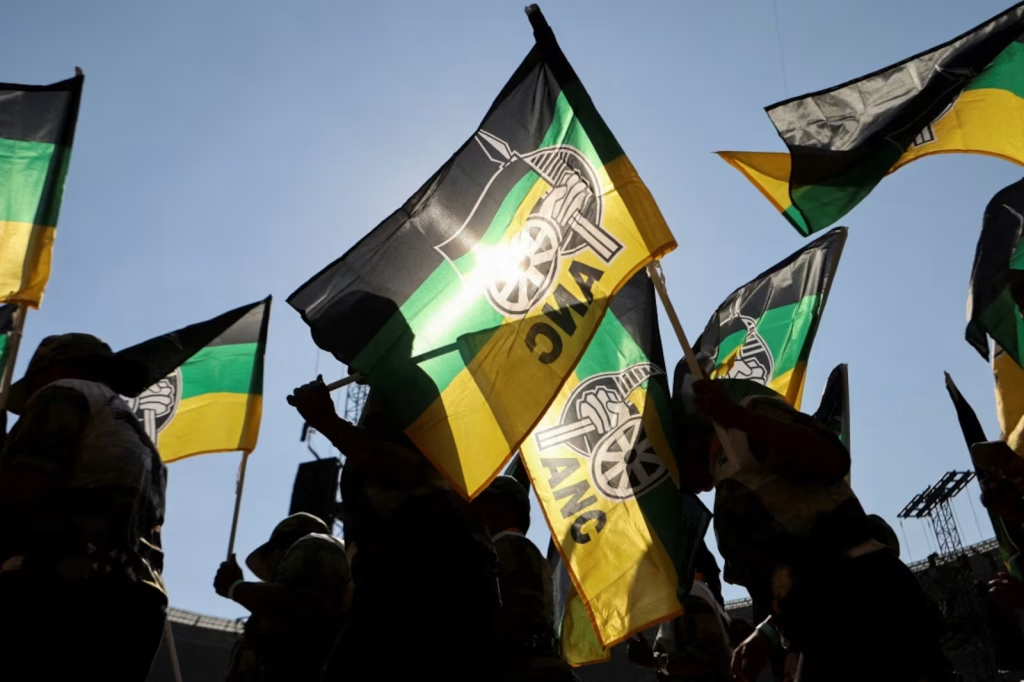
CENTURION, Friday 28 August 2026 — The Electoral Commission has initiated regulatory action against the ANC over R15.27 million in political donations whose disclosures failed to comply with statutory requirements, placing the governing party’s campaign finances under additional scrutiny as South Africa enters the formal campaign period for the 4 November local government elections.
The Electoral Commission of South Africa excluded the transactions from its table of compliant donations for the first quarter of the 2026/27 financial year after identifying deficiencies in submissions made by the African National Congress and its donors.
The disputed declarations comprise R15 million from the Batho Batho Trust and R270,000 from Captrust Investment, according to the commission’s disclosure information.
The IEC said the problems included failures to make the required dual disclosures, missing declarations by either donors or recipients, inadequate proof of underlying transactions, missing supporting documentation and late reporting.
The commission stressed that identifying those deficiencies does not amount to a finding that the donations themselves were unlawful.
Rather, the current dispute concerns whether the ANC and its donors complied with the disclosure and verification requirements governing political funding.
The IEC has issued the ANC with a formal direction under Section 15 of the Political Funding Act requiring the party to address the deficiencies.
Failure to comply could lead to further regulatory action.
The commission said possible consequences include withholding future allocations from the Political Party Representatives Fund and Multi-Party Democracy Fund, while continued non-compliance could ultimately result in referral to the Electoral Court for sanctions.
The latest report also identified approximately R41 million in ANC donations from the 2025/26 financial year that were declared late or had other compliance deficiencies.
Those included two R15 million donations from the Batho Batho Trust, R10 million from Botho Botho Commercial Enterprises, R500,000 from Valumax Projects and an in-kind contribution valued at R501,230.29 from Friedrich Ebert Stiftung.
The IEC said those transactions were also excluded from its tabulated compliant totals while regulatory processes continue.
The development is significant because political parties are rapidly increasing fundraising ahead of November’s municipal elections.
Four parties recorded R116.8 million in compliant donations between April and June, comprising approximately R111.5 million in direct monetary contributions and R5.28 million in in-kind support.
The Democratic Alliance accounted for the overwhelming majority.
It declared approximately R104 million from nine donors, including R30 million from Fynbos Ekwiteit and R25 million from Fynbos Kapitaal.
The party also reported in-kind assistance covering costs including advertising, staffing, legal services and campaign-related expenditure.
ActionSA declared R5.5 million, including R5 million from businessman Martin Moshal and R500,000 from Siyaya Free To Air TV.
The IEC separately flagged the Siyaya contribution because the donor had not submitted the corresponding declaration required to match ActionSA’s filing.
The Labour Party declared R5 million, while RISE Mzansi reported R2.25 million from two investment companies.
The scale of the DA’s fundraising gives the latest disclosures an electoral dimension beyond regulatory compliance.
Political parties are preparing expensive national campaigns for municipal elections in which control of several of South Africa’s largest cities is expected to be closely contested.
Johannesburg, Tshwane, Ekurhuleni and Nelson Mandela Bay are all likely to require significant campaign resources because fragmented voting patterns make outright majorities difficult and relatively small movements in support could alter coalition possibilities.
The ANC is simultaneously attempting to recover municipal support lost over successive elections, while the DA is seeking to expand beyond the councils it currently controls and MK, ActionSA, the EFF and other parties are competing for positions in potentially hung councils.
The IEC has previously taken regulatory action over late political-funding declarations.
Its third-quarter report for the previous financial year recorded a separate R2 million donation from Chancellor House Trust that was declared by the donor within the required period but reported late by the ANC.
The commission issued a Section 15 direction in that case as well.
The latest disclosure report was released on the same day that parties faced another important IEC deadline.
Candidate nominations for the 4 November local government elections closed at 17:00 on Friday, after the commission warned that ordinary submissions or amendments would not be accepted beyond the deadline.
The commission will now verify candidate submissions before publishing final lists on 16 September.
Political-funding oversight will continue in parallel with that process as campaign spending accelerates.
The IEC said it expects political donations to increase substantially as parties raise money for the election and indicated that it would pay particular attention to high-value donations, discrepancies and other potential compliance risks.
The immediate issue for the ANC is whether it can remedy the deficiencies identified in the R15.27 million worth of current-year donations and resolve the separate problems surrounding its late declarations from the previous financial year.
Failure to do so could escalate what is currently a political-funding compliance matter into formal proceedings before the Electoral Court during the final months of the municipal election campaign.