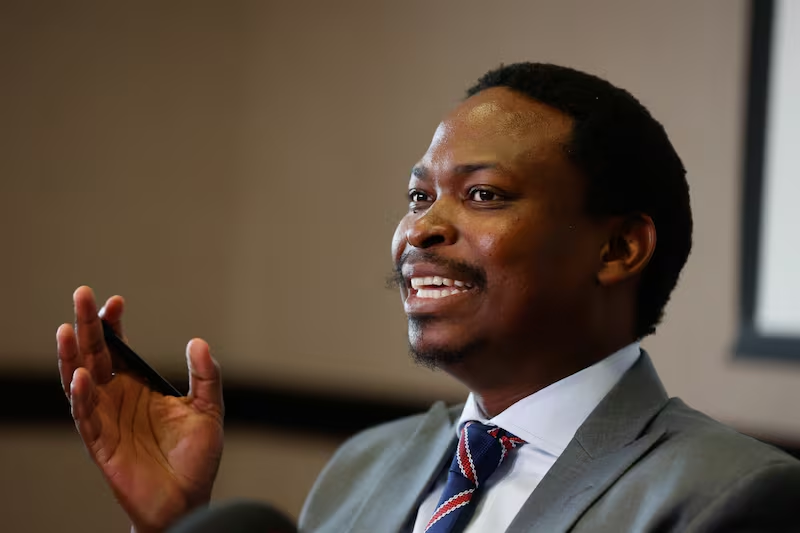
DURBAN, Friday 28 August 2026 — The MK Party has named former Midvaal mayor Bongani Baloyi as its candidate for Johannesburg and unveiled mayoral contenders for five other metropolitan municipalities, completing a major part of its local-election leadership slate hours after candidate nominations closed.
The party announced the candidates following a two-day meeting of its national leadership in Durban on Friday.
Baloyi will lead the MK Party campaign in Johannesburg, while MP Thulani Shongwe has been selected for Ekurhuleni.
Zandile Hlophe-Mkhwanazi will contest eThekwini, Mapaseka Mothibi will lead the party in Mangaung, Mzwandile Vaaibom has been selected for Buffalo City and Mvuleni Mapu for Nelson Mandela Bay.
The uMkhonto weSizwe Party has not yet announced its mayoral candidates for Tshwane and Cape Town.
Secretary-general Sibonelo Nomvalo said those candidates would be announced later.
The Johannesburg selection is particularly significant because Baloyi is one of the relatively small number of candidates in the metro race who has previously governed a municipality.
He served as executive mayor of Midvaal from 2013 until 2021 under the DA and became South Africa’s youngest mayor when he assumed the position at 26.
Baloyi left the DA in 2021, subsequently joined ActionSA and became its Gauteng provincial chairperson before resigning from the party in 2023.
He then established Xiluva, which contested the 2024 national and provincial elections before he dissolved the party and joined MK.
His selection had been the subject of internal debate within MK.
The Sunday Times reported in May that senior members were lobbying for Baloyi to contest Johannesburg because of his municipal experience, while others were concerned about his previous association with the DA and whether established MK members were being overlooked for senior positions.
MK subsequently omitted Baloyi from an election task team announced for Johannesburg, creating uncertainty over whether he remained in contention.
Friday’s announcement resolves that question and places him into an unusually crowded contest for control of South Africa’s largest city.
The DA is campaigning behind Helen Zille, while ActionSA has selected former Johannesburg mayor Herman Mashaba.
The ANC is still deciding between incumbent Mayor Dada Morero, Deputy Mayor Loyiso Masuku and veteran Frank Chikane, with its final mayoral selection expected in September.
The EFF, Patriotic Alliance, IFP, RISE Mzansi and BOSA have also put forward mayoral contenders.
Baloyi’s candidacy could be particularly relevant to post-election coalition negotiations.
MK entered Parliament as the third-largest national party after the 2024 election but has not previously contested a municipal election.
A significant Johannesburg result would give it potential leverage in a council where no major party is currently assured of an outright majority.
The party’s choice of Shongwe for Ekurhuleni is also notable.
Shongwe is an MK Member of Parliament and has been involved in parliamentary proceedings examining allegations surrounding senior police and criminal-justice officials.
He has also appeared before the Madlanga Commission.
Ekurhuleni has been governed through shifting coalition arrangements since the 2021 elections and is another metro where MK’s vote could affect whether the ANC, DA or a broader coalition can assemble a governing majority.
In eThekwini, MK’s selection of Hlophe-Mkhwanazi gives the party a candidate in the largest municipality in KwaZulu-Natal, the province where it received its strongest support in the 2024 national and provincial elections.
That makes eThekwini one of the most important tests of whether MK can convert its provincial support into municipal power.
The party has also selected candidates in all three Eastern Cape and Free State metros outside Gauteng and KwaZulu-Natal that it currently plans to contest under named mayoral leadership.
Mothibi’s selection in Mangaung is particularly noteworthy because she has previous experience in the metro’s turbulent council politics.
She was among ANC councillors expelled from the party during the 2023 struggle for control of Mangaung and participated in the council vote that resulted in opposition councillor Papi Mokoena becoming mayor.
Mapu, MK’s Nelson Mandela Bay candidate, is another figure with previous senior municipal experience.
He served as acting city manager of Nelson Mandela Bay before being removed from the position following court intervention during the metro’s governance crisis in 2020.
Vaaibom, selected for Buffalo City, has also previously occupied senior political positions in the metro, including serving as ANC chief whip before later becoming associated with ISANCO.
The six selections therefore show MK relying in several metros on figures with prior experience in municipal government, other political parties or national institutions rather than exclusively promoting candidates who entered elected politics through the party after its formation.
Nomvalo said the candidates would serve as the faces of MK’s campaigns in their respective metros.
The party also announced an “Asibuyele Ebantwini” campaign aimed at increasing its community-level presence and said its broader election programme, which it calls the People’s Mandate, would be formally released on 4 September.
MK said it would also establish an election operations centre to coordinate its campaign and monitor results during the election.
The announcements came on the day political parties and independent candidates faced the Electoral Commission of South Africa‘s final deadline for candidate nominations.
Nominations closed at 17:00 on Friday, with the IEC having warned that no ordinary late submissions or amendments would be accepted after the deadline.
The commission will now verify submissions before publishing the final list of successful candidates on 16 September.
For MK, the next significant unanswered questions concern Tshwane and Cape Town.
Its eventual choices in those metros will complete the party’s mayoral line-up across South Africa’s eight largest municipalities and provide a clearer indication of the role it expects to play in coalition negotiations if the 4 November election again produces several hung metropolitan councils.