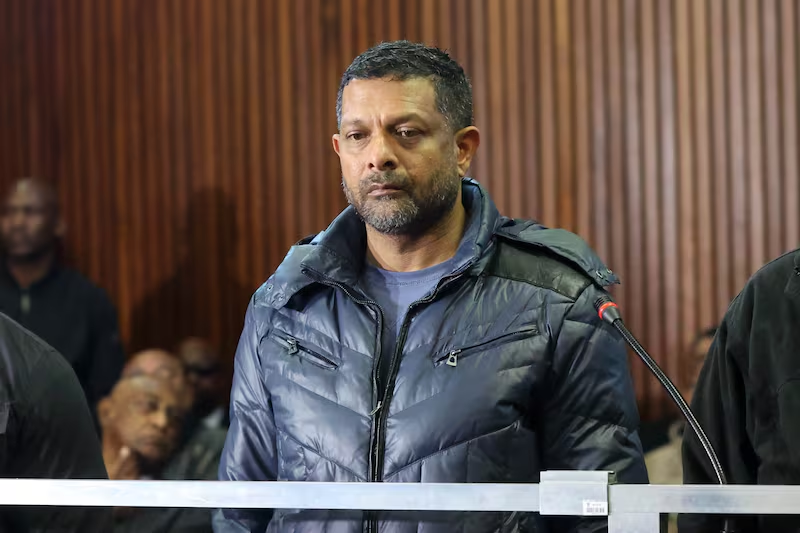
PRETORIA, Tuesday 1 September 2026 — The Madlanga Commission has postponed the testimony of suspended Crime Intelligence deputy head Major-General Feroz Khan to 28 September but imposed conditions requiring an independent medical assessment if he remains unable to appear, as the inquiry seeks to prevent an indefinite delay in hearing evidence from one of the senior police officials at the centre of its investigation.
Khan had been subpoenaed to appear before the commission on Tuesday and Wednesday but was readmitted to hospital shortly before his scheduled testimony.
His lawyers sought a postponement on medical grounds.
Commission chairperson Justice Mbuyiseli Madlanga granted the postponement but ruled that Khan’s subpoena remains in force and placed conditions on any further absence.
Under the ruling, Khan will only be excused from appearing on 28 September on medical grounds if he voluntarily undergoes an independent assessment by 8 September.
The specialist is to be agreed upon by Khan’s legal representatives and the commission’s evidence leaders.
A report from the independent medical practitioner must then be provided to the commission by 15 September.
If the parties cannot agree on a specialist, an independent practitioner will be nominated through the relevant professional medical body, according to reporting on the ruling.
Madlanga also directed that Khan’s diagnosed medical condition may be disclosed to the commission while detailed clinical information, including treatment and personal medical information, remains confidential.
The chairperson said a firm deadline must also be imposed for Khan to provide his outstanding sworn statement.
The measures follow previous delays to Khan’s evidence.
He had initially been expected to testify before the commission in July after being identified as a significant witness in its investigation into allegations of criminality, political interference and corruption within the criminal justice system.
That appearance did not proceed after Khan was shot and wounded in Johannesburg in June.
Tuesday’s postponement followed his latest hospitalisation.
Khan’s evidence is significant because he served as deputy head of South African Police Service Crime Intelligence and has been implicated in several matters examined by the commission.
Allegations made against Khan before the commission have not been established as fact, and he has not yet had the opportunity to give his substantive evidence in response.
His position within Crime Intelligence places him within an institution that has become a central focus of both the Madlanga Commission and Parliament’s parallel investigation into allegations originally raised by KwaZulu-Natal police commissioner Lieutenant-General Nhlanhla Mkhwanazi.
The commission has heard extensive evidence concerning procurement, intelligence operations, appointments and alleged relationships between senior police officials, businesspeople and suspected criminal networks.
Khan also faces criminal proceedings separate from the commission.
He and two co-accused are expected back in the Kempton Park Magistrate’s Court on Wednesday in a corruption case relating to an alleged National Treasury procurement scheme.
Those allegations remain before the courts and Khan is entitled to the presumption of innocence.
The commission’s decision on Tuesday is therefore procedural rather than a finding against Khan.
Its significance lies in Madlanga’s decision to impose an independently verifiable process for determining whether Khan remains medically unable to testify.
The commission adopted a similar approach previously when dealing with another witness whose ability to appear was questioned on medical grounds.
Tuesday’s proceedings also produced further scrutiny of senior Hawks officials.
Former Hawks national head Lieutenant-General Godfrey Lebeya told the commission that he did not regard former KwaZulu-Natal Hawks head Major-General Lesetja Senona as a person of interest after 541kg of cocaine was stolen from a Hawks facility in Port Shepstone.
The drugs, valued at approximately R200 million, had been seized at Durban harbour before being stored at the facility.
Evidence before the commission has indicated that CCTV cameras and alarms at the building were not functioning properly and that there was no continuous security presence.
Lebeya was questioned about why Senona was not subjected to a polygraph examination despite being responsible for keys to the strong room.
He told the commission that he regarded Senona as the complainant rather than a person of interest.
Lebeya also said he could not recall Senona informing him that the cocaine was being stored at the Port Shepstone facility, contradicting Senona’s earlier account that he had informed the national Hawks head.
Lebeya declined to accuse Senona of lying, saying he could not recall receiving the information.
Those competing accounts remain evidence before the commission and no finding has been made about responsibility for the cocaine theft.
Attention will now turn to whether Khan undergoes the independent medical assessment by 8 September and whether the resulting report clears him to appear on 28 September.
If he is medically able to testify, his appearance would give the commission its first opportunity to question one of Crime Intelligence’s most senior suspended officers directly about allegations that have featured repeatedly during months of evidence.