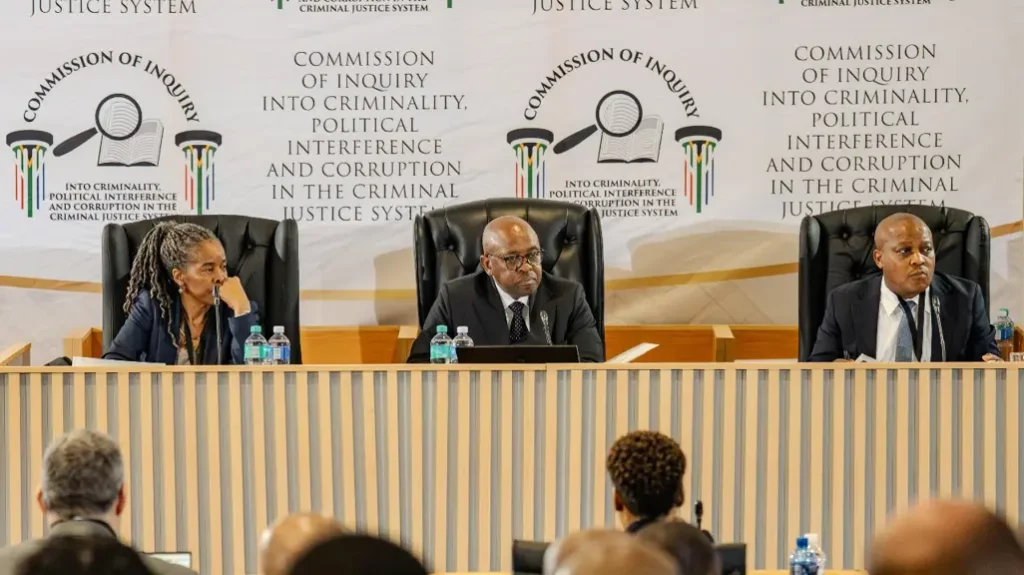
PRETORIA, Wednesday 2 September 2026 — Political assassinations in South Africa are increasingly affecting parties beyond the ANC, with the MK Party emerging as the most targeted political organisation in recent data, organised-crime expert Mark Shaw told the Madlanga Commission on Wednesday.
Shaw, executive director of the Global Initiative Against Transnational Organised Crime (GI-TOC), was giving expert evidence to the commission about organised crime, contract killings and the infiltration of South African institutions.
His evidence comes little more than two months before the 4 November local government elections and on the same day that the IFP confirmed the death of uMlalazi councillor and Ward 17 candidate Khethelo Mdluli after he was shot at his KwaZulu-Natal home.
The IFP has called for police to investigate every possible motive in Mdluli’s killing, including whether it was politically motivated. No motive has yet been established.
Shaw told the commission that political assassinations historically occurred predominantly within the ANC but had increasingly spread across political parties.
According to Shaw’s research, the latest data indicates that the uMkhonto weSizwe Party is now the political organisation most affected by such killings.
He said close to 30 suspected political hits had already been recorded during 2026, although the research covering the current year has not yet been formally published.
Shaw cautioned that his assassination database is compiled from open-source information and should therefore not be regarded as a complete record of every politically motivated killing in the country.
KwaZulu-Natal continues to account for the largest concentration of political assassinations, according to his evidence.
Asked for a precise provincial breakdown, Shaw told the commission he did not have the figures immediately available but would provide them later.
The province is one of the most consequential battlegrounds in November’s municipal elections.
The MK Party, ANC and IFP are competing for control of municipalities across KwaZulu-Natal, while the province has also experienced a series of killings involving councillors, candidates and other politically active figures.
Shaw described violence commissioned for political purposes as one of the tangible consequences of South Africa’s organised-crime economy.
He said contract killings interfere with democratic political activity at local level and can draw individuals into organised criminal networks to carry out targeted attacks.
His evidence formed part of a wider assessment of the scale of organised crime confronting South Africa.
Shaw told the commission that South Africa ranks among the top 5% of countries globally for criminal markets and criminal actors, based on GI-TOC’s Global Organised Crime Index.
He placed South Africa seventh among the 193 countries assessed by the index.
The research also highlighted severe concentrations of violence in individual cities.
Shaw’s evidence identified Gqeberha as one of the world’s cities most severely affected by territorial gang violence, while Cape Town was also cited for entrenched gang territoriality.
The Madlanga Commission is investigating allegations concerning criminal syndicates, political interference and the possible infiltration of the country’s criminal justice institutions.
Its work followed allegations made by KwaZulu-Natal police commissioner Lieutenant-General Nhlanhla Mkhwanazi about interference in policing and investigations.
Shaw’s testimony does not establish that individual killings attributed to political violence were ordered by political parties, nor does the finding that MK Party members have increasingly been targeted establish who was responsible for those attacks.
The evidence instead identifies a changing pattern in the victims recorded by researchers.
That distinction will be particularly important during an election campaign in which individual killings can quickly generate allegations between political rivals before police investigations have established a motive.
With municipal campaigning intensifying, political violence in KwaZulu-Natal and other contested areas is likely to receive increasing scrutiny from parties, law-enforcement agencies and election authorities.
Further evidence before the Madlanga Commission, as well as the publication of Shaw’s complete 2026 political-assassination data, could provide a clearer picture of how the pattern has changed ahead of the municipal vote.