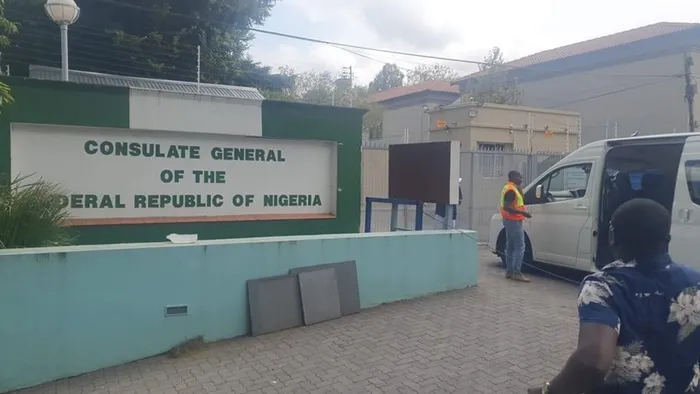
JOHANNESBURG, Friday 4 September 2026 — Johannesburg has disconnected electricity and water services to Nigeria’s consulate in Illovo over an outstanding municipal account of about R7 million, as Mayor Dada Morero intensifies the city’s revenue-recovery campaign amid wider diplomatic tensions between South Africa and Nigeria.
Morero accompanied City Power and Johannesburg Water officials during the enforcement operation and publicly confirmed that the Consulate General of Nigeria had been disconnected.
“Our teams have just disconnected the Consulate General of Nigeria in Illovo, where their municipal account currently reflects an outstanding balance of approximately R7 million,” Morero said in a statement posted from his official mayoral account.
Electricity had already been cut and Johannesburg Water had also enforced action against the property, according to the mayor.
EWN reported the operation on Friday after the municipal action was carried out on Thursday, 3 September.
The Nigerian government had not publicly disputed the R7 million figure in the sources available by Friday afternoon.
The disconnection should therefore be understood as a municipal revenue-enforcement action rather than a diplomatic sanction.
There is no evidence that Johannesburg targeted the consulate because it represents Nigeria or that the action was connected to current disagreements between Pretoria and Abuja over the treatment of Nigerian citizens in South Africa.
Morero said the city’s position was that residents, companies and institutions receiving municipal services must settle their accounts.
The operation also targeted a Shell filling station in Rosebank as part of the same broader enforcement drive.
Johannesburg has been intensifying disconnections as it attempts to recover substantial outstanding municipal revenue.
In March, the city targeted national and provincial government properties that collectively owed significant amounts for electricity and water.
At the time, Johannesburg said government departments alone owed the municipality approximately R1.4 billion.
Its enforcement operations included disconnecting services at buildings occupied by the Gauteng departments of Cooperative Governance and Health.
Municipal officials said continued non-payment constrained Johannesburg’s capacity to fund services.
The Nigerian consulate case is nevertheless politically sensitive because it comes during a period of increased tension between South Africa and Nigeria over migration and anti-foreigner mobilisation.
Nigeria said this week that 1,640 of its citizens had been evacuated from South Africa, with funding secured for another 500 voluntary one-way departures.
Mzansi Political Safari reported earlier on Friday that Abuja has increasingly raised the treatment of Nigerians and other African migrants at bilateral and African Union level.
The Johannesburg disconnection is unrelated to those evacuations on the available evidence.
But its timing means a routine municipal debt dispute involving a diplomatic mission could attract wider attention in relations between two of Africa’s largest economies.
It is also not the first time a Nigerian diplomatic facility has faced municipal disconnection in South Africa.
In February, Tshwane disconnected electricity at the Nigerian High Commission in Pretoria over unpaid municipal services as part of Mayor Nasiphi Moya’s Tshwane Ya Tima revenue campaign.
The High Commission subsequently settled the outstanding account and Tshwane announced that electricity would be restored.
Johannesburg’s City Power also disconnected the Nigerian consulate over unpaid electricity accounts in 2023.
The substantially larger amount cited by Morero this week indicates that the current dispute extends beyond that earlier account.
The enforcement action takes place as Johannesburg itself heads into an intensely competitive municipal election.
The ANC governs the city through a minority arrangement under Morero, while the DA, ActionSA, EFF, MK Party and other organisations are attempting to reshape the council in November.
Revenue collection, infrastructure maintenance and the financial condition of Johannesburg have become major issues in the campaign.
The city’s decision to disconnect government, commercial and diplomatic properties therefore serves both an administrative and politically visible purpose: demonstrating that Johannesburg intends to enforce payment regardless of the identity of the account holder.
That does not establish whether the R7 million account is disputed, whether any payment arrangement existed or whether diplomatic considerations could affect the enforcement process.
Those questions remain unresolved.
The next material development will be whether Nigeria’s consulate pays or challenges the account, whether services are restored and whether South Africa’s Department of International Relations and Cooperation becomes involved.