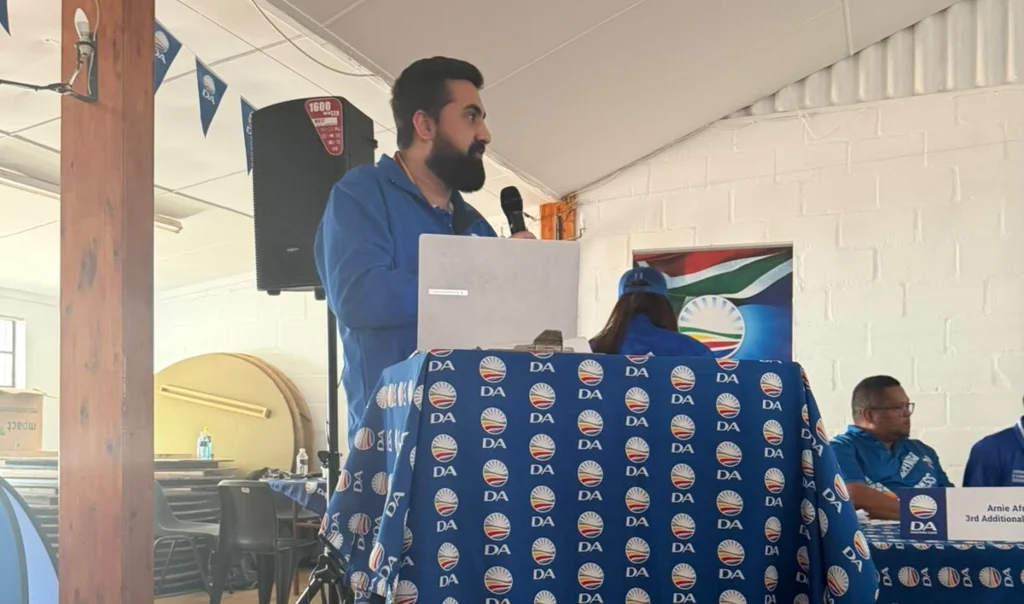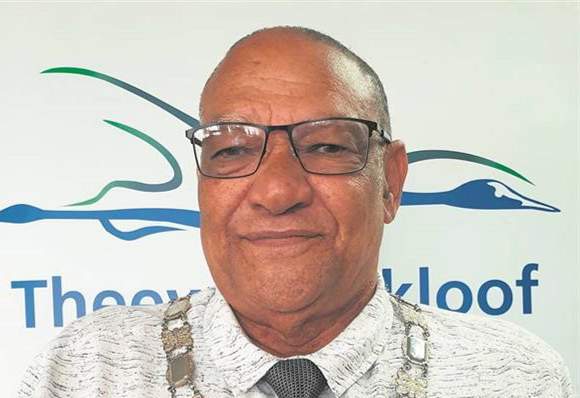
THEEWATERSKLOOF, Thursday 1 October 2026 — Democratic Alliance councillor Lincoln de Bruyn has been removed as executive mayor of Theewaterskloof after the ANC, Patriotic Alliance and EFF combined against him in council, reopening a leadership battle in the financially distressed Western Cape municipality just over a month before the local government elections.
De Bruyn was removed on Wednesday, 30 September, in the latest shift in control of a council that has experienced repeated coalition changes, litigation and financial intervention since the 2021 municipal elections.
The DA confirmed his removal on Thursday morning, accusing the ANC and PA of driving renewed instability in the municipality.
The opposition parties’ support for De Bruyn’s removal does not by itself establish a new governing arrangement, and no verified announcement identifying a successor as executive mayor was located at the time of publication.
ANC, PA and EFF combine against De Bruyn
Regional newspaper Hermanus Times reported that the ANC, PA and EFF joined forces to remove De Bruyn from office during Wednesday’s council proceedings.
DA Western Cape leader Tertuis Simmers subsequently confirmed the change and accused the ANC and PA of prioritising political positions over municipal stability.
“The ANC and PA once again joined forces to remove Mayor De Bruyn,” Simmers said in a statement issued on Thursday.
The DA said De Bruyn’s administration had been implementing the municipality’s Financial Recovery Plan while attempting to maintain essential services.
Those assessments are the DA’s political characterisation of its administration.
The ANC has previously disputed the DA’s account of the municipality’s financial performance and accused the DA-led administration of presiding over deteriorating finances and governance.
Previous removal was overturned by High Court
Wednesday’s vote is particularly notable because it is not the first time opponents have removed De Bruyn from the mayor’s office.
He initially became executive mayor in August 2024 after a political realignment displaced the ANC-PA administration.
Weeks later, a motion of no confidence removed him and Freedom Front Plus councillor Theunis “Tienie” Zimmerman was elected as his replacement.
The DA and De Bruyn challenged that process in the Western Cape High Court.
The court ultimately declared both De Bruyn’s removal and Zimmerman’s subsequent election unconstitutional, unlawful and invalid.
Judge James Lekhuleni found that the council process had been procedurally defective, including problems surrounding the convening of the special meeting and the notice provided for the motion against De Bruyn.
The ruling restored De Bruyn to the mayoral position.
ANC councillors later attempted to intervene and appeal the decision, but that application was dismissed by the High Court in February 2025.
The legality of Wednesday’s new removal has not been determined by a court.
No basis has therefore been established at this stage to suggest that the latest vote suffers from the same procedural defects identified in the earlier litigation.
Coalition instability has repeatedly changed control
Theewaterskloof has been governed without a single-party majority since the 2021 local elections.
The DA emerged as the largest party with 11 of the council’s 27 seats, while the ANC won eight and GOOD three.
Fourteen seats are required for a council majority.
An initial post-election arrangement involving the ANC, PA, GOOD and EFF resulted in PA councillor Karel Papier becoming mayor.
After Papier’s death in 2023, fellow PA councillor Mary Liebenberg succeeded him.
A further political realignment in 2024 saw GOOD move into an arrangement with the DA and Socialist Revolutionary Workers Party, enabling De Bruyn to take the mayoralty.
His first removal, Zimmerman’s brief election and the subsequent High Court reversal followed within months.
Wednesday’s vote represents another change in the balance of power before voters elect a new council on 4 November.
Political turmoil overlaps with financial intervention
The leadership contest is unfolding against serious financial problems in the municipality.
Theewaterskloof was placed under financial intervention in 2024 and subsequently became subject to a Financial Recovery Plan.
The municipality has faced concerns over debt, Eskom arrears, water security, infrastructure and administrative instability.
The political parties disagree over responsibility for those problems.
Earlier this year, the ANC alleged that municipal debt had risen above R400 million and that Eskom arrears had increased substantially under the DA-led administration.
It also accused the administration of management instability and inadequate action on water supply problems.
Those figures and allegations were advanced by the ANC and should not be interpreted as independent findings of wrongdoing by De Bruyn.
The DA, by contrast, says De Bruyn’s administration inherited a financial crisis and had been working through the recovery plan to stabilise the municipality.
SIU investigation adds pressure on municipality
The municipality is also facing scrutiny unrelated to Wednesday’s coalition vote.
President Cyril Ramaphosa has authorised the Special Investigating Unit to investigate allegations involving maladministration, corruption and irregular expenditure in Theewaterskloof.
Among the matters identified for investigation is the procurement of 14 backup generators intended for boreholes and pump stations.
The existence of an SIU investigation does not establish wrongdoing by the municipality, individual councillors or officials.
It adds, however, to the governance pressures facing the council as political control again changes hands.
Removal comes five weeks before election
The timing sharply limits the period during which any new political arrangement can govern before voters decide the composition of the next council.
South Africans vote in the local government elections on 4 November, meaning Wednesday’s removal came five weeks before polling day.
Theewaterskloof’s experience since 2021 also provides a direct example of the coalition instability that has become a prominent issue in the 2026 municipal campaign.
The DA is using De Bruyn’s removal to argue that it needs an outright majority to prevent further coalition changes.
The ANC, PA and EFF will have the opportunity to contest that account as campaigning intensifies.
The immediate next development will be the council’s leadership arrangements following De Bruyn’s removal and whether a new executive mayor is elected before the end of the current council term.
Any legal challenge by De Bruyn or the DA would also be significant given the High Court’s intervention after the previous attempt to remove him.