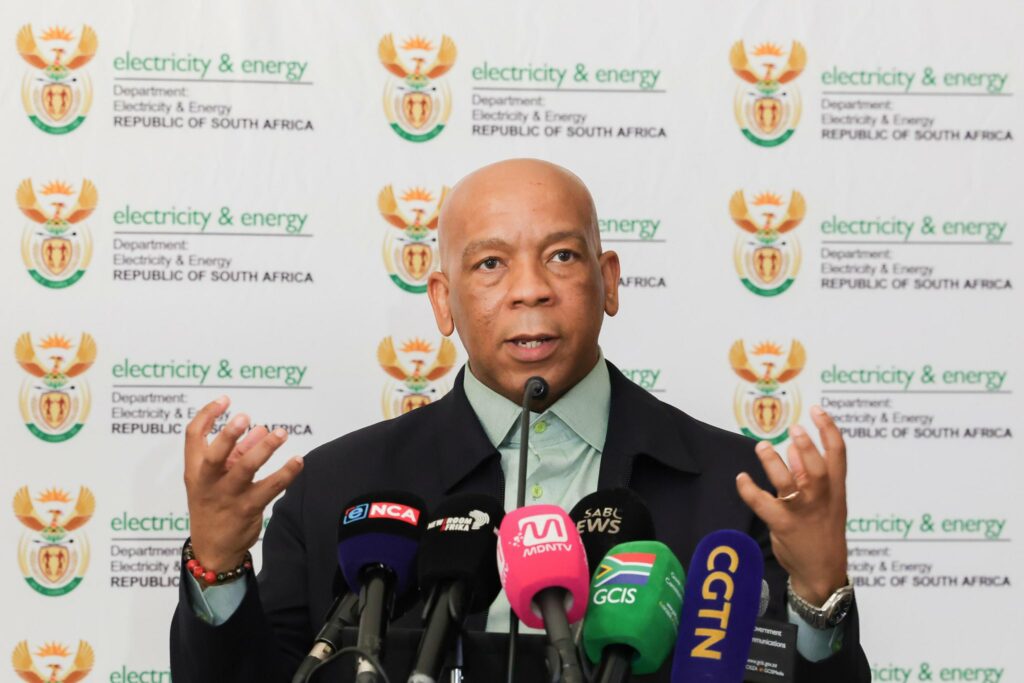
PRETORIA, Wednesday 7 October 2026 — Electricity and Energy Minister Kgosientsho Ramokgopa has announced plans to procure 9,600MW of new battery storage and gas-fired generation capacity as government moves to prevent emerging constraints in South Africa’s electricity system from developing into another supply crisis.
The proposed Section 34 determination provides for 4,600MW of battery energy storage and 5,000MW of gas-to-power generation.
Government is prioritising the two technologies under the first procurement phase flowing from the Integrated Resource Plan 2025, while further wind and solar capacity will be addressed through a later determination.
Ramokgopa said the intervention was necessary because the electricity system increasingly needs capacity capable of storing surplus power and releasing it when demand rises.
He warned that failing to address the problem early could place South Africa at risk of returning to electricity-supply constraints.
Battery procurement brought forward
Government intends to procure the full 4,600MW battery-storage allocation identified under the IRP rather than waiting for the capacity to be introduced incrementally later in the planning period.
The IRP had anticipated about 2,200MW of storage being procured by 2030.
Ramokgopa said the acceleration was necessary because the electricity system is already experiencing periods of surplus generation that cannot always be efficiently absorbed by the network.
Battery facilities can absorb electricity during periods of excess supply and return it to the grid when demand increases.
Government argues that expanding storage will also make it easier to integrate additional renewable generation without forcing the system operator to curtail available electricity.
Ramokgopa said further renewable capacity entering the system would intensify the problem if storage and transmission constraints were not addressed.
Government plans another 5,000MW of gas
The determination also provides for an additional 5,000MW of gas-to-power generation.
Gas generation is intended to provide dispatchable electricity that can be activated when required, complementing variable generation sources such as wind and solar.
An earlier gas-to-power procurement round closed for bids on 29 May and is undergoing final evaluation.
The newly announced 5,000MW allocation would form part of a subsequent procurement round.
Wind and solar projects are expected to form part of a later Section 34 determination, potentially including hybrid projects combining renewable generation with storage.
Longer-term pumped-storage capacity is also expected to form part of government’s broader electricity planning.
State-led power parks planned
Ramokgopa also announced a State-led Power Parks Programme intended to reduce some of the infrastructure and regulatory barriers facing electricity developers.
Under the programme, the state would prepare strategic sites by addressing issues including land approvals, technical studies and bulk infrastructure before developers enter the projects.
The aim is to reduce development costs and make participation easier for emerging electricity producers while expanding ownership within the sector.
The Independent Power Producer Office is expected to oversee procurement.
Ramokgopa said another power-parks procurement round would be announced before the end of 2026, with procurement expected before the end of the financial year.
Eskom would be permitted to participate in the programme alongside private generators.
Electricity challenge shifts from shortage to flexibility
The announcement comes after a prolonged improvement in South Africa’s generation position following years of severe load shedding.
Government now faces a different challenge: ensuring that available generation can be moved, stored and delivered where and when it is required.
Ramokgopa said some parts of the country continued experiencing electricity interruptions despite periods in which the national system had surplus generation.
Those problems include affordability constraints, municipal distribution failures and limitations in the transmission and distribution networks rather than insufficient national generation alone.
The proposed 9,600MW determination will now form part of government’s procurement programme as it attempts to expand flexible generation and storage while additional renewable projects enter the grid.