PRETORIA, Saturday 12 September 2026 — The Freedom Front Plus has launched its manifesto for the 4 November local government elections, putting decentralised municipal government, merit-based appointments, infrastructure maintenance and tighter control of rates and taxes at the centre of its campaign while positioning itself as a potential stabilising partner in fragmented councils.
Party leader Corné Mulder launched the manifesto in Pretoria on Saturday, saying the FF Plus expects coalition governments to become increasingly common after the election and arguing that multiparty administrations can work if parties honour agreements and maintain stable decision-making.
The launch is significant because the FF Plus already participates in coalition and multiparty arrangements and has named mayoral candidates across several politically important Gauteng municipalities, including Johannesburg, Tshwane and Ekurhuleni.
Its electoral strategy is therefore aimed not only at winning additional council seats but at increasing the party’s leverage in councils where no single organisation secures a majority.
Mulder expects more councils to require coalitions
Mulder said coalition governments were likely to become a reality in many municipalities after November.
He acknowledged that unstable coalitions could delay decisions and undermine service delivery but argued that well-managed multiparty governments could broaden representation, constrain abuse of power and force collective decision-making.
The FF Plus has increasingly presented itself as a party capable of functioning as a smaller but disciplined coalition partner.
Its manifesto explicitly states that the party intends to act as a balance of power in multiparty governments where voters produce fragmented councils.
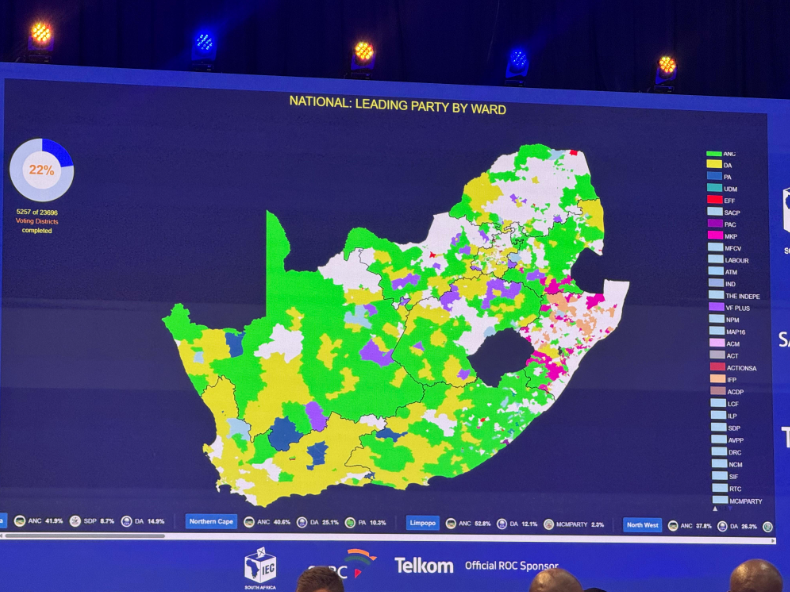
That positioning could matter particularly in metropolitan councils where polling and recent electoral trends suggest outright majorities may be difficult to achieve.
Johannesburg, Tshwane, Ekurhuleni and Nelson Mandela Bay have all experienced coalition or minority governments during the current municipal term.
Ten-point plan focuses on municipal basics
The FF Plus’s municipal platform is structured around a 10-point plan.
Among its principal commitments are merit-based appointments, greater decentralisation of municipal decision-making, what the party describes as fair rates and taxes, stronger private-sector participation and increased infrastructure maintenance.
The party also identifies reducing water losses from leaking infrastructure as a specific municipal priority.
Other commitments include stronger oversight of mismanagement and corruption, protection of cultural heritage and multilingualism, and what the party describes as creating safer and healthier communities.
The manifesto reflects a long-standing FF Plus argument that municipalities should concentrate principally on core local-government functions rather than expanding administrative structures.
Decentralisation forms central part of proposal
One of the clearest structural proposals is greater devolution of municipal authority.
The FF Plus says government functions should be exercised as close to communities as possible, including through sub-councils and smaller municipal structures where appropriate.
The proposal reflects the party’s broader emphasis on community autonomy and decentralised decision-making.
In large metropolitan municipalities, sub-councils or similar structures could potentially give neighbourhoods more direct influence over local priorities.
How extensively such reforms could be implemented would depend on existing municipal legislation, council structures and the powers available to individual councils.
Merit-based appointments remain core campaign position
The party is also campaigning for municipal appointments to be made on what it describes as merit rather than racial criteria.
Its manifesto says municipalities should appoint the best-qualified people available and reduce political or ideological considerations in recruitment.
The proposal is consistent with the FF Plus’s broader opposition to race-based transformation policies.
Local-government staffing has become a significant campaign issue across parties because poorly qualified appointments, vacancies in technical posts and instability among municipal managers have repeatedly been identified in Auditor-General and departmental assessments of failing municipalities.
The FF Plus argues that professionalising municipal administrations is necessary to improve services regardless of which political parties control councils.
Infrastructure maintenance prioritised over repeated repair
The manifesto places particular emphasis on infrastructure.
The FF Plus says councils should prioritise routine maintenance of electricity, water, sanitation and road networks rather than allowing assets to deteriorate until emergency interventions are required.
Water losses receive specific attention.
The party argues that leaking pipes and failing municipal systems waste scarce resources while increasing the financial pressure on councils and residents.
Those issues have become particularly important ahead of the election as major metros confront water interruptions, ageing electricity networks, sewer failures and deteriorating roads.
Private-sector partnerships form part of service-delivery approach
The FF Plus also wants municipalities to create what it describes as a favourable environment for private-sector investment and job creation.
Where councils lack the capacity to maintain or restore infrastructure, the party has advocated partnerships involving businesses and communities.
Its Gauteng campaign has framed functional municipalities as necessary for wider economic recovery.
The party argues that unreliable electricity, water interruptions and deteriorating logistics infrastructure increase business costs and discourage investment.
That economic argument places local government at the centre of the FF Plus’s wider campaign rather than treating municipal elections primarily as contests over individual service-delivery complaints.
Gauteng metros among key targets
The party has already named candidates for the three Gauteng metropolitan municipalities.
Franco de Lange is its Johannesburg mayoral candidate, Willie Spies is contesting Tshwane and Jennifer Glover has been selected in Ekurhuleni.
The FF Plus has also announced mayoral candidates in Emfuleni, Mogale City, Merafong, Rand West City, Lesedi and Midvaal, as well as the Sedibeng and West Rand district municipalities.
Its Gauteng leadership has said those candidates were chosen partly for council or community experience and would seek coalition agreements where the election produces no outright winner.
The party is unlikely to govern the largest metros alone, making its coalition strategy particularly relevant to its prospects of influencing municipal administrations after the vote.
Coalition record becomes campaign asset — and test
Mulder’s emphasis on coalition stability comes as South Africa debates possible national legislation intended to reduce repeated changes of mayors and municipal executives.
Coalition instability has been especially severe in Johannesburg, where several mayors have served during the current council term.
Tshwane and Nelson Mandela Bay have also experienced periods of political uncertainty linked to changing alliances.
The FF Plus argues that smaller parties need not be destabilising simply because they hold the balance of power.
Its electoral pitch is that it can use that position to influence larger parties while maintaining agreed governing arrangements.
Whether voters accept that argument will partly determine the party’s bargaining position after November.
Manifesto enters increasingly crowded municipal campaign
The FF Plus launch adds another national platform to an election contest in which most established parties are now moving from candidate announcements to municipality-specific campaigning.
The ANC, DA, EFF, ActionSA, IFP and several smaller formations are competing particularly aggressively in metropolitan councils where fragmented results could again require coalition governments.
The FF Plus enters that contest as a smaller national party but one capable of becoming consequential when one or two seats determine whether a governing coalition has a majority.
That makes the party’s explicit commitment to functioning as a “balance of power” more than campaign rhetoric.
In closely divided councils, the number of FF Plus councillors elected on 4 November could determine which larger parties are capable of assembling governing majorities — and what policy concessions they must make to do so.