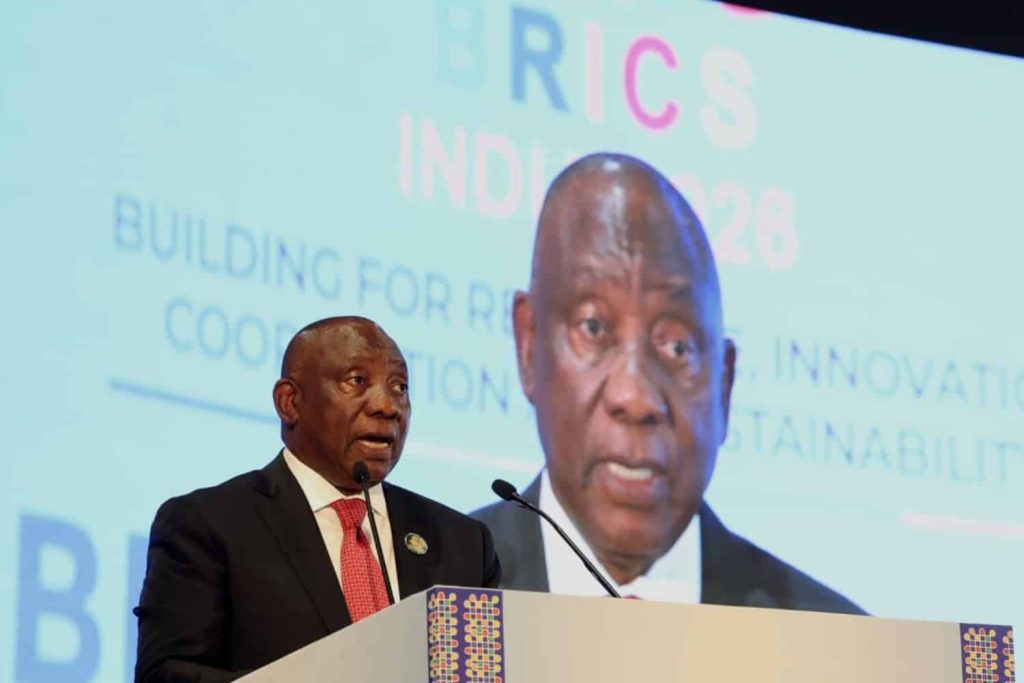
NEW DELHI, Saturday 12 September 2026 — President Cyril Ramaphosa has used South Africa’s intervention at the BRICS leaders’ summit to describe the current war against Iran as illegal and the situation facing Palestinians as an ongoing genocide, setting out a sharper national position than the more carefully negotiated language contained in the bloc’s joint declaration.
Addressing a closed BRICS leaders’ session on global governance and multilateralism in New Delhi on Saturday, Ramaphosa argued that international law was being applied selectively and said accountability was required for atrocities in Palestine, Sudan and Iran.
Ramaphosa referred explicitly to “the ongoing genocide against the Palestinians”, “crimes committed against the people of Sudan” and what he called “the illegal war against Iran”.
The language represents South Africa’s national position and should be distinguished from the New Delhi Declaration, which BRICS leaders adopted separately on Saturday using more general consensus language on conflict, restraint and international law.
Ramaphosa says international law cannot be selective
Ramaphosa framed the remarks around what he described as an erosion of the United Nations-centred international system.
He told BRICS leaders that multilateral institutions and established rules were increasingly being ignored or undermined and argued that countries should be held to the same legal standards regardless of their political or military power.
“International law cannot be applied selectively,” the president said.
He argued that the same principles governing sovereignty, territorial integrity, political independence and the lawful use of force should apply to every state.
Ramaphosa said South Africa continued to support a global order centred on the UN Charter and opposed the use of military force except where permitted by international law.
Iran wording goes further than BRICS declaration
The reference to an “illegal war against Iran” is particularly significant because Iran itself is a full BRICS member and current tensions in the Middle East have complicated negotiations inside the bloc.
South Africa has previously criticised military action involving Iran.
In February, Ramaphosa called for restraint after the latest escalation and said disputes should be resolved diplomatically rather than through military confrontation.
DIRCO later described the use of force by the United States and Israel against Iran as unlawful under the UN Charter and criticised attacks on Iranian territory.
In June, South Africa welcomed a US-Iran memorandum intended to end military operations and said the agreement could halt what International Relations Minister Ronald Lamola described as an unlawful use of force.
Ramaphosa’s Saturday remarks therefore continue an established South African legal position, but place it personally and directly before BRICS heads of state at a time of renewed regional instability.
IAEA dispute adds complexity to Iran relationship
South Africa’s position does not mean Pretoria has endorsed every action by Tehran.
Earlier this year, South Africa told the UN Human Rights Council that Iranian authorities were required to respect peaceful protest, protect life and ensure that any security response met standards of legality, necessity and proportionality.
Iran is also under renewed international scrutiny over its nuclear programme.
The International Atomic Energy Agency’s board this week referred Iran to the UN Security Council over alleged breaches of its non-proliferation obligations, the first such referral in two decades. Reuters reported that Russia, China and Niger opposed the resolution.
That makes Pretoria’s approach more nuanced than simple political alignment with Tehran: South Africa is opposing what it considers unlawful military force while continuing to support multilateral accountability mechanisms.
Palestine remains central to South African foreign policy
Ramaphosa’s description of an “ongoing genocide” against Palestinians is consistent with South Africa’s legal case against Israel at the International Court of Justice.
South Africa instituted proceedings under the Genocide Convention and has repeatedly argued that Palestinians in Gaza face a risk of genocide.
The ICJ has issued provisional-measures orders in the case but has not yet delivered a final merits judgment determining whether genocide has occurred.
That distinction remains important.
South Africa’s use of the term “genocide” reflects the government’s legal and political position in the proceedings; the Court has not yet made a final finding on the underlying allegation.
Pretoria submitted new ICJ material in August
South Africa’s government remains actively engaged in the litigation.
DIRCO said on 28 August 2026 that Pretoria had submitted a substantial dossier to the ICJ concerning what it describes as Israel’s failure to comply with provisional measures ordered by the Court.
The government said the submission was intended to assist judges monitoring implementation of those interim measures.
Israel filed its substantive response to South Africa’s written case in March this year.
DIRCO said at the time that South Africa would decide whether to seek permission for additional written submissions or proceed towards the oral stage of the case.
Ramaphosa’s remarks therefore come while the legal process remains active rather than after a completed judgment.
BRICS declaration uses broader language
The distinction between Ramaphosa’s speech and the collective BRICS position is politically important.
The declaration adopted by BRICS leaders on Saturday calls for restraint, diplomatic settlement of disputes and adherence to international law but avoids language assigning responsibility for specific Middle Eastern conflicts.
That reflects the bloc’s need to maintain consensus among states with significantly different relationships with the United States, Israel, Iran and Gulf governments.
South Africa is not similarly constrained when expressing its own foreign-policy position.
Ramaphosa therefore used the leaders’ session to articulate Pretoria’s legal interpretation more directly than BRICS was collectively prepared to do.
Ramaphosa renews call for Security Council reform
The president linked the conflicts to a wider argument that the international system itself requires reform.
He said Africa’s lack of permanent representation on the UN Security Council was neither just nor sustainable, noting that the continent accounts for 54 UN member states and close to one-fifth of the world’s population.
Ramaphosa renewed South Africa’s support for a more representative, accountable and effective Security Council.
He argued that BRICS should serve both as a platform for reform and as a bridge between increasingly divided geopolitical blocs.
The Presidency had identified reform of the UN, international financial institutions and the multilateral trading system as key South African objectives ahead of the New Delhi summit.
South Africa casts BRICS as defender of multilateral rules
Ramaphosa told fellow leaders that BRICS should not merely challenge existing power structures but demonstrate that multilateral cooperation can produce practical outcomes.
He highlighted infrastructure, food security, health, industrialisation and climate resilience as areas in which the New Development Bank and other BRICS institutions could strengthen the credibility of collective action.
That argument positions South Africa differently from interpretations of BRICS as simply an anti-Western geopolitical alliance.
Pretoria has generally characterised the grouping as part of a broader effort to make international institutions more representative rather than replace one dominant bloc with another.
Strong wording may draw diplomatic scrutiny
Ramaphosa’s explicit description of the Iran conflict as illegal and the situation in Palestine as genocide is likely to attract attention beyond the summit because it leaves little ambiguity about Pretoria’s interpretation of international law.
It also comes while South Africa continues to manage important commercial and diplomatic relationships with the United States, Europe, Gulf states and BRICS partners.
Those relationships do not prevent Pretoria from taking positions that differ sharply from Washington or other Western capitals.
South Africa has repeatedly argued that its foreign policy is grounded in international law rather than alignment with any particular geopolitical bloc.
Saturday’s intervention puts that claim into especially direct language.
The next question will be whether South Africa seeks to translate those positions into further diplomatic or legal action through the United Nations, the ICJ, BRICS or other multilateral forums after the New Delhi summit concludes.